Renting a storage unit for e-commerce: when self storage can help online sellers
By TrovaStorage. Last updated: .
You started selling online from home. At first a few boxes in a corner of the living room were enough, but over time new products, packaging and shipping supplies arrived. Now part of the room is taken up by stock, and every time you have to prepare an order you waste time looking for what you need.
It is a situation that can arise for anyone running a small e-commerce business, selling through online marketplaces or starting a retail business without a warehouse.
When stock starts taking up too much space, moving it out of the house can become a necessity. Renting a traditional warehouse may be too big a commitment, especially if the business is still growing.
One option is renting a self storage unit for e-commerce: a private space inside a dedicated facility, where you can keep products, stock and shipping supplies.
It works simply: you rent a unit, arrange your things inside it and can access it on your own during the facility's opening hours.
Before choosing, though, it is important to know that a self storage unit is not automatically an operational warehouse. Whether you can pack parcels, receive supplies or arrange courier collections depends on the terms of each facility.
When your e-commerce stock no longer fits at home
People who start selling online often use their home to store products too.
A spare room can become a small store, while boxes, labels and packaging find a place in cupboards or the garage. As long as the business is small, this arrangement can work.
As stock (and sales!) grow, though, the available space shrinks. It becomes harder to keep personal belongings separate from stock and to quickly find the products to ship.

The problem can also affect people who sell seasonal items, attend trade fairs or buy supplies they don't use often.
In these situations, having an outside store lets you free up your home and keep products in a dedicated place.
A self storage unit can be useful above all when you need to keep stock and collect it yourself, without necessarily renting a shop or a standalone warehouse.
Being able to access the store on your own can make managing stock simpler, within the facility's opening hours.
Before deciding, it is still important to be clear about how you intend to use the space. Storing products you collect from time to time is different from needing a place to prepare and ship orders every day.
Self storage, traditional warehouse or logistics service: the differences
As your online business grows, you can consider different ways of managing your stock.
A traditional warehouse may be suitable if you need premises for handling products on an ongoing basis, with features suited to the operations you carry out and a compatible permitted use.
Another option is to rely on a logistics provider specialising in e-commerce. In this case, depending on the service chosen, the company can store your stock, prepare orders and handle shipping.
It is a solution to consider when you would rather hand over part of the logistics than organise every operation yourself.
Self storage offers a private space to store your goods, while keeping the ability to access it on your own.
It can suit people who want to manage their own stock and are looking for a store separate from their home.
Some facilities may offer extra services or allow certain operations, but these are not features common to all facilities.
So the choice depends on what you need to do with your stock, not just on where you want to keep it.
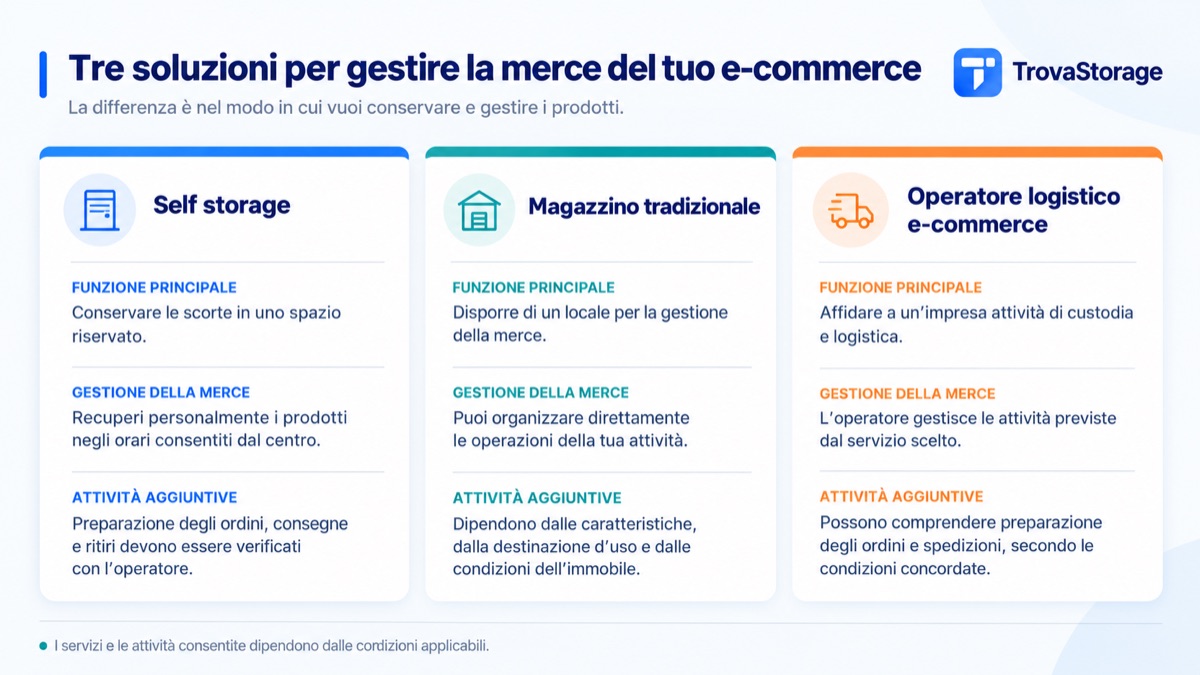
If you mainly need storage and independent access, self storage is an alternative worth considering. If instead you want to hand order preparation and distribution to someone else, a logistics service may be more suitable.
What to check before renting a unit for your e-commerce business
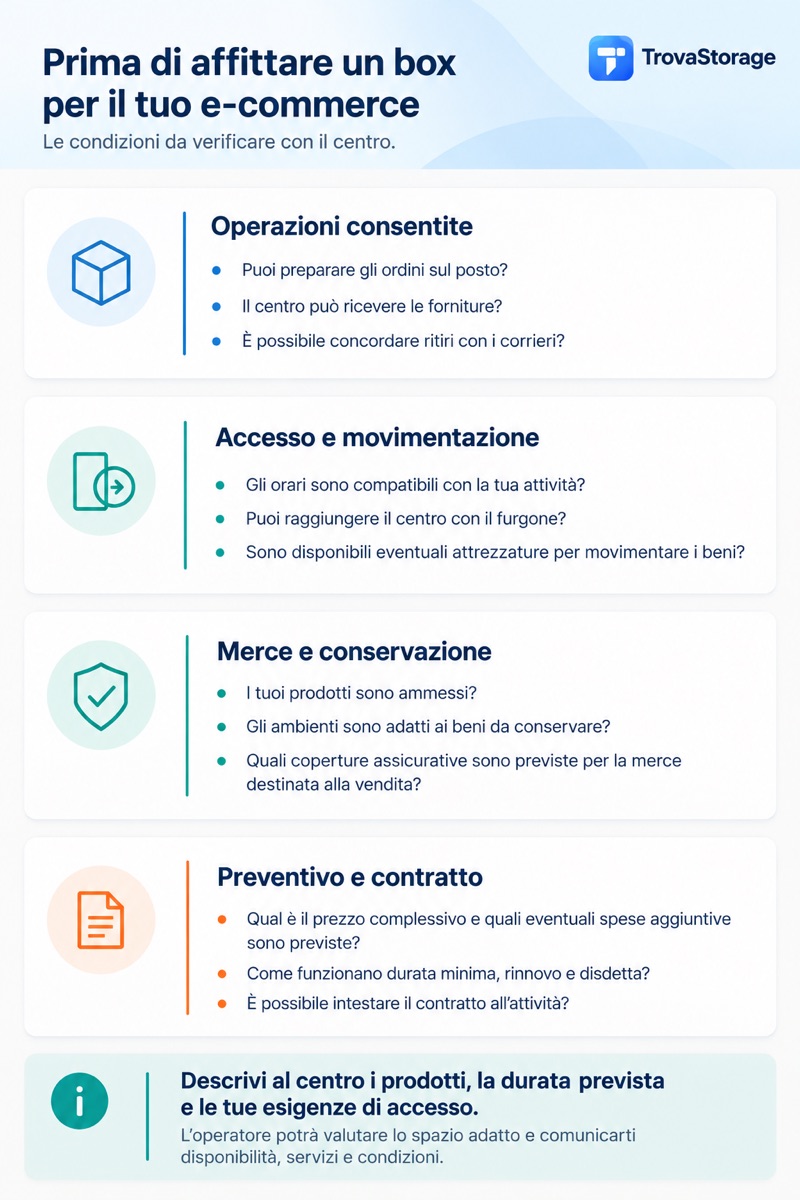
When you use a store for a business, some aspects become particularly important.
The first concerns the operations you can carry out inside the facility.
If you plan to prepare orders on site, ask explicitly whether this is allowed. Some facilities may provide dedicated areas, while others require the unit to be used only for storing goods.
The same goes for deliveries.
If you receive goods from suppliers, check whether the facility can accept parcels or supplies in your name. Not all operators offer this service and, where it is available, specific terms may apply.
Courier collections also need to be agreed. Don't assume that a courier can enter the facility or collect parcels directly from your unit.
Access hours are another decisive factor.
If you handle orders yourself, you may need to collect products in the evening or at weekends. So check that the facility's hours fit the way you work.
Also pay attention to the conditions inside and to security.
If you sell delicate items, electronics, clothing or goods sensitive to damp and temperature, ask about storage conditions.
Also check which goods are allowed. Food, cosmetics, chemicals and flammable materials may be subject to restrictions or bans, depending on the type of product and the facility's rules.
Another point to clarify is insurance for goods intended for sale. Ask about any cover available, the risks insured and the limits that apply, without assuming the terms are the same as those for personal belongings.
Finally, check the contractual and financial side.
If you are registered for VAT, ask whether the contract can be in your business's name and what tax documents are issued. For any doubts about the tax treatment of the cost, speak to your accountant.
Always ask for a personalised quote that states the total price, the services included and any additional costs.
Also check the minimum rental period, how renewal works and the notice period for ending the contract. Some operators may let you switch units as your needs change, but this depends on availability and on the facility's terms.
How to organise your stock and choose the most convenient facility
A unit used to store products for sale needs to be organised differently from furniture storage during a move.
Things don't just need to be kept safe: you may need to collect them often, check stock levels or add new supplies.
It can help to use labelled boxes and group stock by type, keeping the products you collect most often within easy reach.
If you want to put up freestanding shelving, ask the facility first whether it is allowed and what rules you need to follow. Avoid placing delicate products directly on the floor when conditions call for particular care.
If packing parcels is allowed, also arrange packaging and labels so you have them to hand without constantly moving stock around.
To choose the right unit, talk directly to the facility's advisor.
Describe the products you sell, how they are packaged, whether any are fragile and whether you need to collect stock often. Also say how long you expect to use the store.
The operator will work out the space you need and the features best suited to your business.
The facility's location deserves just as much attention.
If you expect to visit the unit often, a facility near home, on your daily route or convenient for drop-off points can make getting around easier.
Also check whether you can arrive by van, whether there is parking and whether trolleys or a goods lift are available.
The nearest facility is not necessarily the best one: what matters most is being able to use the store without complicating how you handle orders.
---
On TrovaStorage.it you can search for self storage facilities in the area you are interested in, look through the information available and find the operators to contact.
You can also select up to three facilities and send a free request for advice and a quote, with no obligation.
In the request, describe the type of goods, storage needs, how long you expect to need the unit and how often you will need to access it. If you need particular services, such as accepting deliveries, ask explicitly whether they are available.
The selected operators will reply directly, telling you the right space, availability, the total price and the terms of the service.
Comparing this information will help you understand whether a self storage unit can meet the needs of your e-commerce business or whether you need a different logistics solution.