History of self storage, part 2: how it spread from the United States to Italy
By Manfredi Miraula. Last updated: .
In 1972, along a busy road in California, a storage facility opened with a feature that was hard to miss: a row of orange doors, clearly visible even to people driving past.
It was the first Public Storage facility, one of the companies that would help turn self storage into a service known and used by millions of people.
In the first part of our story, in Italian, we told how we got from the warehouses of ancient Rome to the first American storage units, which appeared between the late 1950s and the 1960s.
The new idea was simple: instead of handing your belongings to a custodian, you could rent a private space and access it on your own.
From those first stores, some of them built to hold work equipment, self storage would set out on a long journey. First across the United States, then into Europe and finally to Italy, where the service would arrive only many years later.
Along the way, the buildings would change, as would the ways of getting in and the very way people search for and rent a unit.
California, 1972: the orange doors that made self storage recognisable
Kenneth Volk, an American real estate entrepreneur, had noticed in Houston the demand for small self storage units, with people always on a waiting list.
It was an interesting sign: there were customers willing to pay for a space to keep their things, while still being able to collect them on their own.
Volk decided to develop the idea together with B. Wayne Hughes, and in 1972 they opened the first Public Storage facility in El Cajon, California, next to a very busy road.
The first customer was a motor oil distributor who needed somewhere to keep their stock. A business use, then, not so different from that of a small trader looking for somewhere to store goods today.
The facility's orange doors were a clear signal, visible from the road, and the name chosen, Public Storage, also communicated the service simply. The business took off, and by 1974 the company was already running twenty facilities.
The facilities began to change. Alongside simple rows of units came more elaborate buildings, multi-storey structures, internal corridors and spaces with different features. The business, which had started without a precise aim, soon caught the attention of real estate companies, which began to take an interest in the sector.
For people renting a unit, though, the main advantage remained the original one: having a private space to keep their belongings and being able to collect them without depending on a custody and redelivery service.
An idea that would also begin to spread across the Atlantic.
Self storage reaches Europe: it starts in the United Kingdom
According to FEDESSA, the European federation of the sector, self storage arrived in Europe in the early 1980s, landing first in the United Kingdom.
At first growth was slow.
The service was little known, and people who needed to store furniture during a move turned mainly to companies specialising in furniture storage.
A fundamental difference still had to be explained: with self storage you were not simply handing your things over to a company, but renting a space to use on your own.
According to a 2002 article in the magazine Inside Self-Storage, after the slow initial phase there were around four hundred facilities in the United Kingdom, while across Europe as a whole there were roughly seven hundred and fifty.
In 1995 Shurgard opened its first European facility in Brussels, Belgium, helping the sector develop in other countries.
Self storage first found a place in urban areas, especially in cities where homes lack extra storage space such as cellars, attics and shared storage rooms.
It kept spreading, though at a different pace from one country to another. In their 2025 industry report on the European market, FEDESSA and CBRE confirm the sector's growth in many EU countries.
When did self storage arrive in Italy?
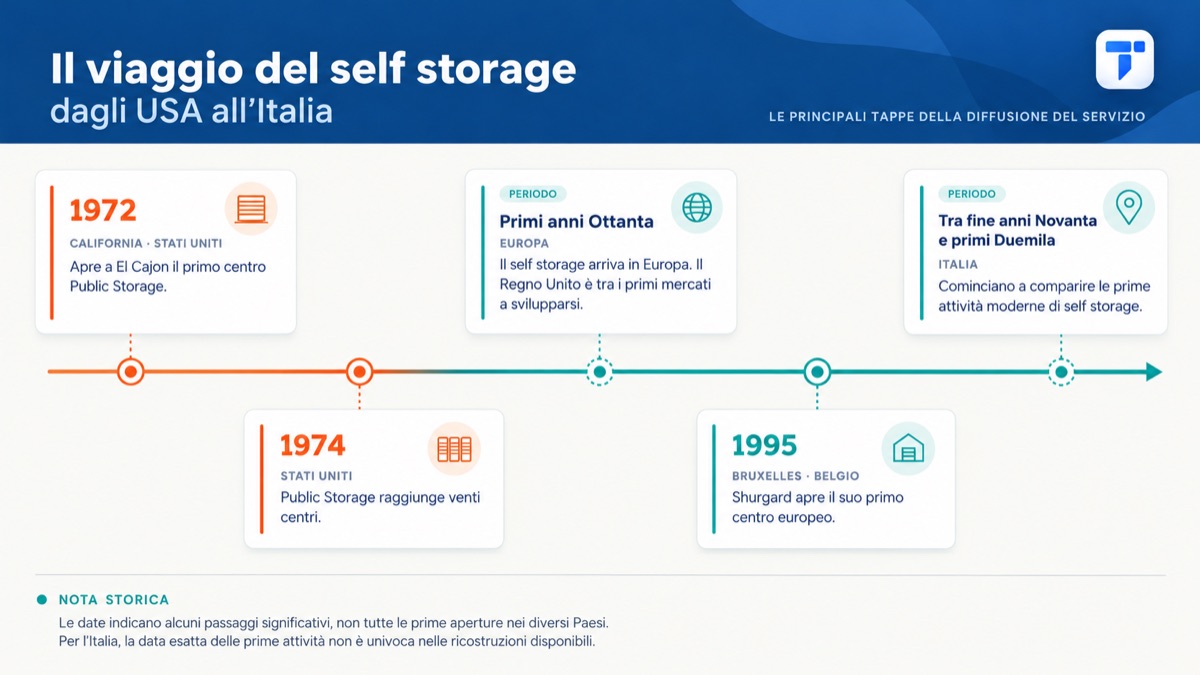
In Italy, the first signs of interest in the sector only appeared in the late 1990s and early 2000s.
Easybox and Casaforte are remembered among the operators that first got the Italian market going. Easybox, for example, gives 2001 as its year of founding.
The early operators' first challenge was explaining how the service worked and what advantages it offered over the solutions Italians were used to.
According to a 2018 article by the Italian association AISI, after a period of growth in the early 2000s the sector slowed down because of the 2008 economic crisis. The market then started growing again, especially in large cities, where living space kept shrinking and becoming more and more expensive.
Even today, facilities are not spread evenly across the country. In some areas there is more choice, while in others finding a self storage facility within easy reach can be harder.
For anyone looking for self storage, this means the search has to take into account not just distance, but also the features and terms of the facilities available.
While self storage was spreading in Italy, another change was transforming the sector: technology.
From key to smartphone: how access to units has changed
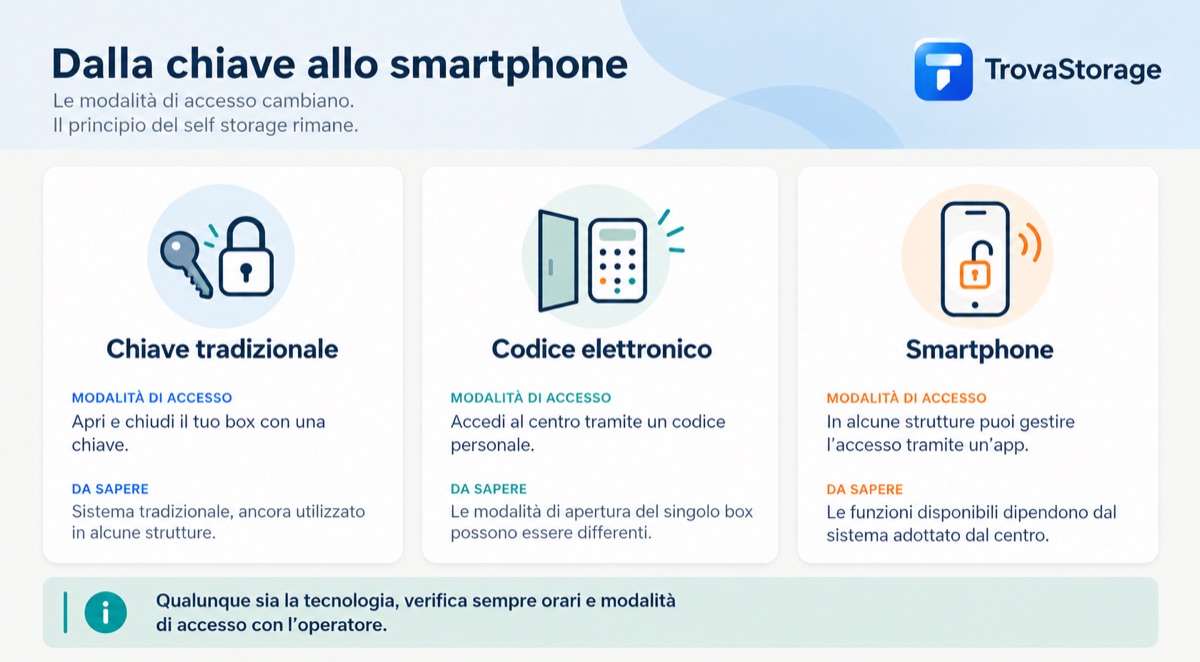
In the first American facilities the set-up was basic: a door, a padlock and a key. Whoever rented the unit kept their own key and could collect their things according to the facility's rules.
As the sector developed, the first electronic entry control systems arrived, and keys gave way to keypads and smartphones. Customer management and bookings have also evolved and gone digital.
According to the 2025 FEDESSA and CBRE report, some operators let you complete various rental steps online. The processes and technology used vary from facility to facility.
For anyone looking for self storage today, what matters most is knowing when and how they will be able to get into their unit. Before renting a space, it is worth checking how entry works, the permitted hours and any restrictions set by the facility.
From the first American roll-up doors to electronic locks, the principle of self storage has stayed essentially the same: a private space, managed directly by the person who rents it.
Today, as in the 1960s, people who are moving house or renovating may need to store furniture and boxes for a while. People moving home may not yet know where to put some things, while a small business may be looking for somewhere to keep materials and equipment.
There are more options now, but choosing the right one still means understanding your needs and comparing the terms on offer.
**In the third and final part of our story, Renting a unit today: why people use self storage and when it can help, we will come back to exactly these everyday situations.**
We will look at why people choose a store, what the differences are between self storage, a garage and a mover's furniture storage, and what to consider before renting a unit.