Furniture storage after a bereavement, a separation or a family member's move
By Davide Padeletti. Last updated: .
How to clear the home in the time required and calmly decide what to keep, together with the people involved
The wardrobes are still full: clothes, photographs, documents, objects that have been part of a whole life. The home has to be cleared, perhaps by a set date, but you don't yet know what to keep, what to give away and what to sell. And perhaps, right now, you are not even in a state of mind to decide.
It happens after a bereavement, during a separation or when a parent leaves their home for a smaller one, to go and live with a son or daughter, or to move into a care home. In all these cases temporary storage serves one purpose only: to separate the urgency of emptying the home from the decision about what to do with each item.
One of the possible solutions is self storage: you rent a private unit in a dedicated facility, put your furniture and boxes in it and can come back to collect them whenever you need, during opening hours. It is not always the right choice, though. In this guide we also look at the alternatives and at how to organise yourself when you are not the only one deciding.
When the home has to be cleared before you have decided what to keep
After a bereavement
Often the home has to be handed back to the landlord, put up for sale or prepared for someone else, and the timing is set by paperwork, not by grief. Meanwhile, among the furniture there are things worth little on the market but a great deal to those who lived with them: grandad's armchair, the dinner service for special occasions, the boxes of photos. Choosing what to keep takes time, especially if brothers, sisters and relatives want their say.
During a separation
Here the problem is practical: where does the furniture from the home you shared go? Whoever moves out often ends up in a flat that is already furnished or too small. Putting the sofa, the bookcase or the children's bedroom aside for a few months means you don't have to sell anything off cheaply and can reorganise calmly.
When a family member moves home
An elderly parent who moves in with a son or daughter or with other relatives, perhaps into a smaller flat or a care home, can rarely take everything with them. Some furniture will go to children or grandchildren; for other pieces it will take time, because deciding what to take with you is also a way of still feeling in charge of your own life.
In all three cases storage is a bridging solution: it gives a place to the things that don't yet know where to go, without forcing you into a final decision.
Inheritance and separation: who decides what happens to the furniture?
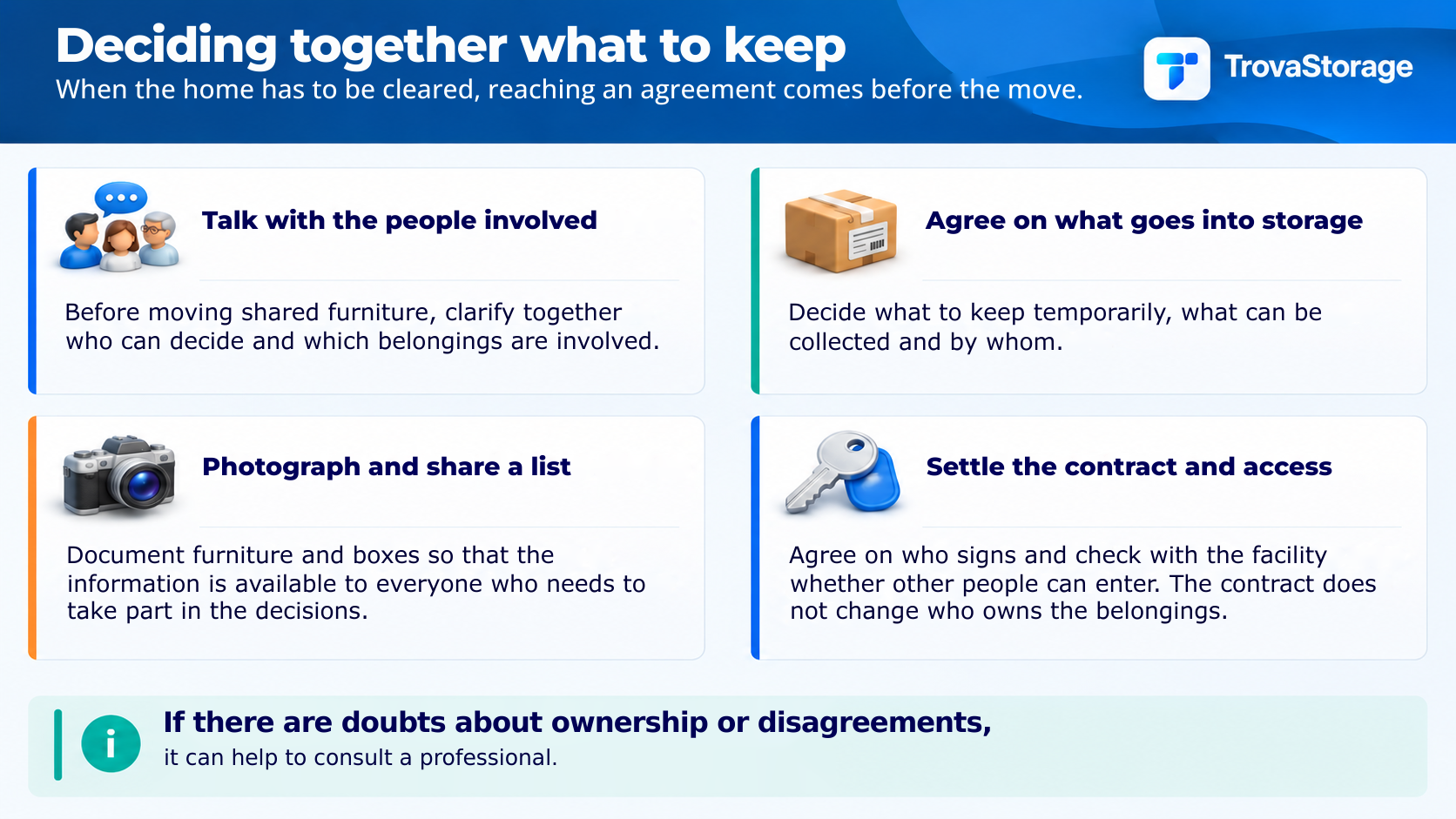
Finding a place for the furniture is only half the problem. The other half is understanding who has the right to decide what happens to it.
After a death, the furniture becomes part of the estate. If there is more than one heir, they become co-owners of the belongings, each for their share, until the estate is divided: this is what the Italian Ministry of Justice calls comunione ereditaria (joint ownership of an inheritance). In practice, before moving, giving away or selling anything, you need to talk to all the heirs, and if there are disagreements it is best to resolve them before the move, with the help of a notary or a lawyer if needed.
In a separation, on the other hand, you need to distinguish personal belongings from shared ones. Who a piece of furniture belongs to depends on the specific situation and, for married couples, on their property regime (community or separation of property).
Storage does not untangle these knots: it offers a temporary space, and to avoid arguments later:
- agree beforehand with the others on which items go into storage and who will be able to collect them;
- photograph the furniture and write an inventory of the boxes to share with everyone;
- remember that having the unit contract in your name does not make you the owner of what is inside. Whoever signs is answerable to the facility (payments, rules, termination), while the furniture remains the property of whoever owned it, or of all the heirs together. If other family members need to be able to get in, this has to be arranged according to the facility's rules.
Wills, original documents, cash, jewellery and valuables deserve separate attention. Many facilities don't accept them or exclude them from the insurance: for these, a bank safe deposit box or another suitable form of safekeeping is better.
Where to put the furniture: cellar, furniture storage or self storage?
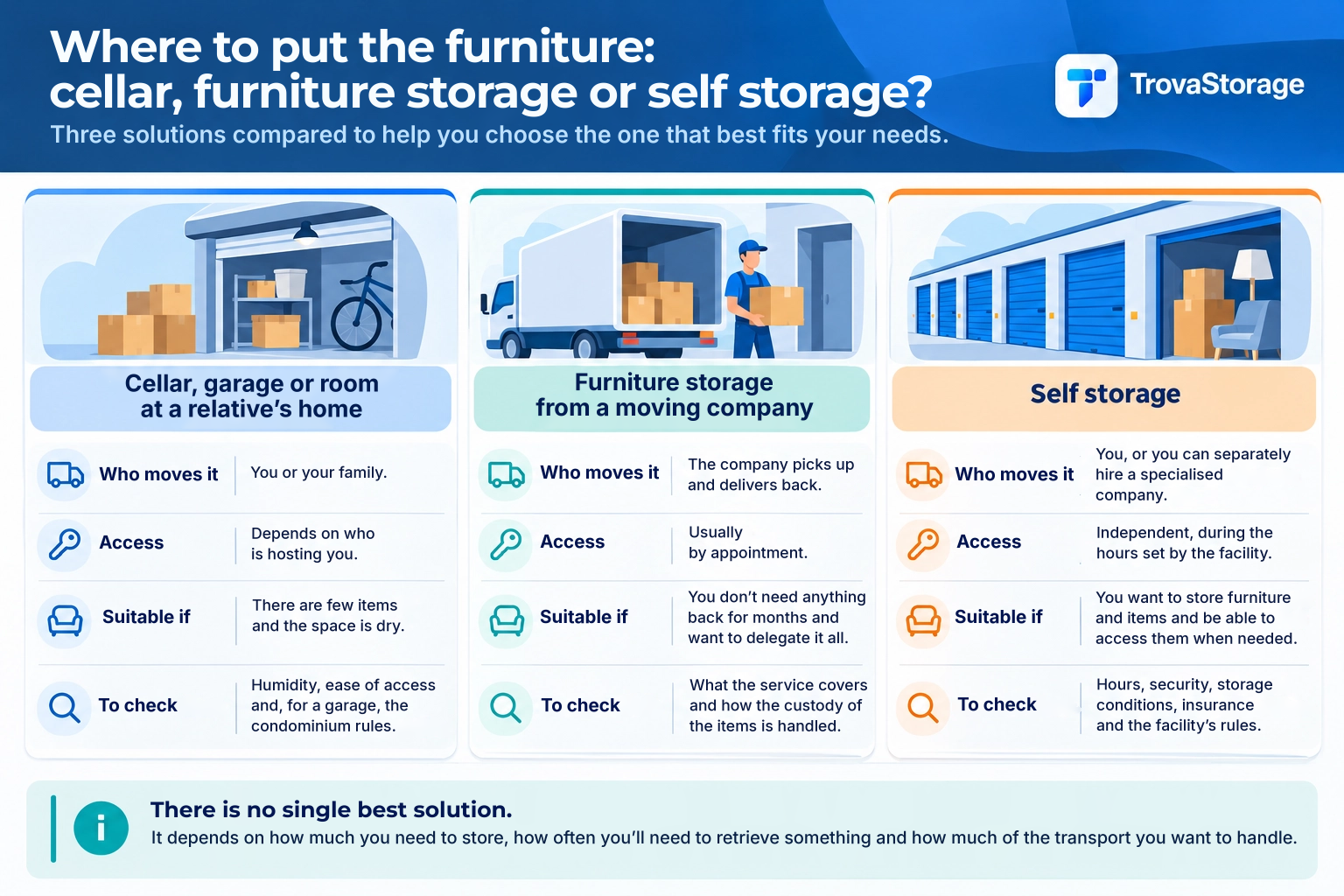
There is no single best solution: it depends on how much you need to store, how often you will need to retrieve something and how much of the transport you want to handle yourself.
- Cellar, garage or room at a relative's home. Who moves it: you or your family. Access: depends on who is hosting you. Suitable if: there are few items and the space is dry. To check: humidity, ease of access, condominium rules for the garage.
- Furniture storage from a moving company. Who moves it: the company picks up and delivers back. Access: usually by appointment. Suitable if: you don't need to retrieve anything for months and want to delegate everything. To check: what the service includes and how you ask for redelivery.
- Self storage. Who moves it: you, or a firm you hire. Access: on your own, during the facility's hours. Suitable if: you want to keep the furniture but be able to go back for photos, boxes or documents. To check: minimum term, insurance, access with a van.
You might consider whether the family cellar is the simplest choice when there are only a few things, but a damp space can ruin wood, books and photographs within a few months. Furniture storage with a moving company takes all the effort off your hands: depending on the service, the company dismantles, collects, stores and delivers back. With self storage, instead, you rent a private unit and go in yourself whenever you need to, without having to ask anyone.
Checklist before the move
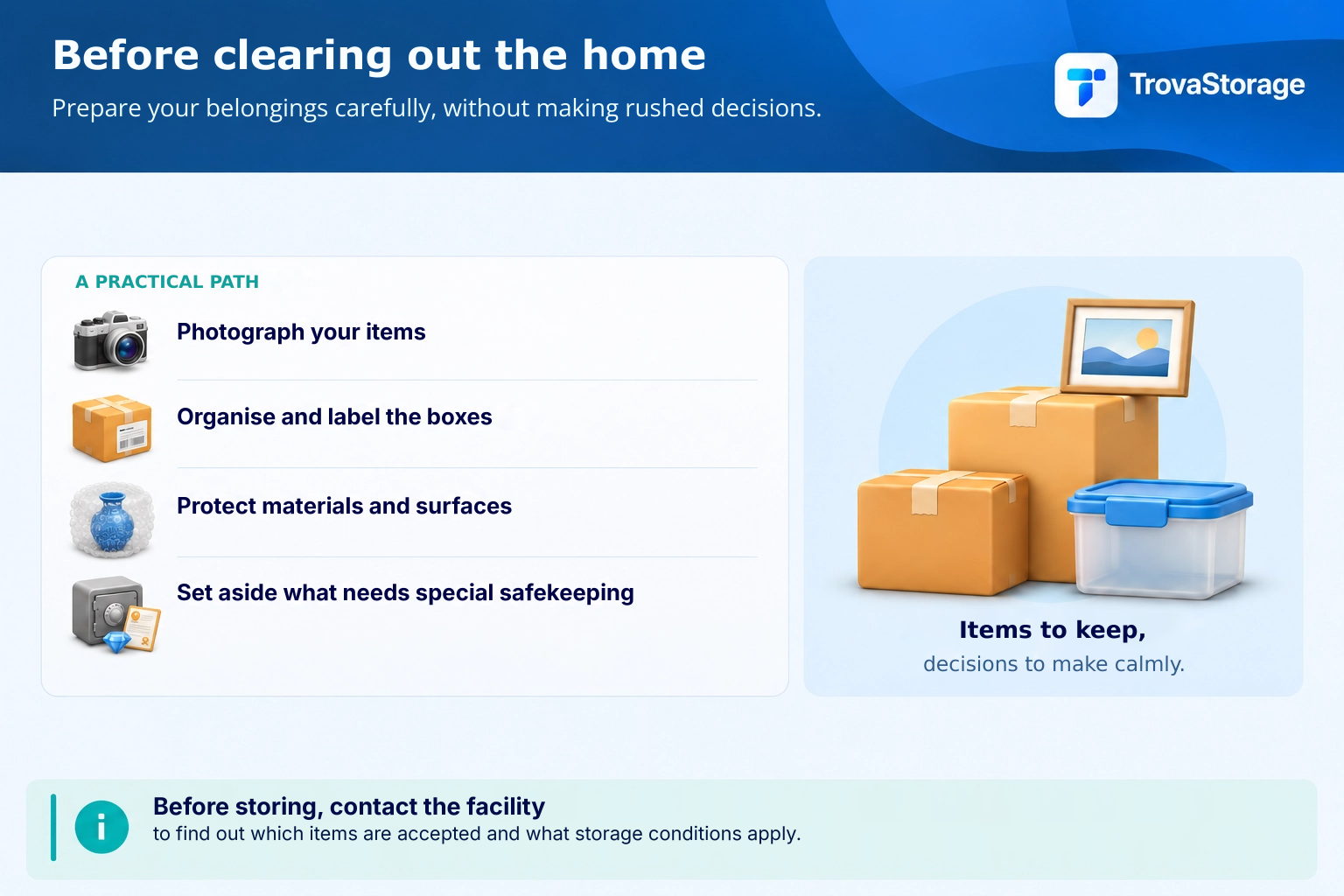
- Make the list with everyone concerned: what goes into storage, what goes to whom, what is given away or sold.
- Photograph the furniture before dismantling it: the photos will also help document its condition.
- Number the boxes and keep a shared inventory. A spreadsheet or a note on your phone is enough.
- Dismantle whatever can be dismantled, such as beds, wardrobes and tables: they take up less space and get damaged less. Put screws and small parts in a labelled bag, fixed to the piece of furniture.
- Protect wood and fabrics with breathable covers, not sealed plastic, which traps moisture.
- Set aside documents, jewellery and valuables: they don't go in the unit.
- Empty and thoroughly dry fridges and washing machines before storing them.
- Leave out food, plants and flammable liquids: almost all facilities prohibit them.
- Put the things you expect to retrieve first at the front.
How to choose storage when the timing is uncertain
After an inheritance, a separation or a family member's move, you almost never know how long you will need the space: perhaps only until the home is sold, perhaps a whole year. That is why, before signing, you should always ask:
- the minimum term of the contract;
- how it renews, automatically or on request;
- how much notice is required to terminate it.
If the unit will be used by several family members, decide together whose name it goes in and how to split the payments. Then ask the facility whether other people can be authorised to access it, and how.
Look at the practical side too:
- Location and opening hours: if you expect to go often, being close matters more than a few euros' difference.
- Access with a van: check that loading and unloading are easy.
- Humidity: essential for wooden furniture, books, photographs and fabrics.
- Security and insurance: ask which systems are in place and what the policy covers.
You don't have to work out the square metres yourself
Tell the advisor what you need to store, for example "a double bedroom set that can be dismantled, a three-seater sofa, an antique sideboard and around twenty boxes". Add whether there are fragile items, how long you think you will need it and how often you will need to get in. They will suggest the right unit for you.
When you compare quotes, look at the total price: on top of the rent there may be a deposit, insurance or other services charged separately.
Ask for a quote on TrovaStorage.it
On TrovaStorage.it you can search for self storage facilities in the area you are interested in and compare the information available. Then you select up to three facilities and send a single request for advice and a quote, free and with no obligation.
In the request, describe what you need to store and what you need. The operators will reply to you directly, with availability, the recommended unit, the total price and the terms of the service.
Frequently asked questions
How much does a self storage unit cost?
It depends mainly on the city, the size of the unit and the operator. In the guide How much self storage costs in Italy you will find the starting prices recorded by the TrovaStorage Index and how to read them. For the final price, including deposit and insurance, search for facilities in your area and ask for a written quote.
Does furniture storage cost less than self storage?
The two prices can't be compared at a glance: self storage is usually paid per unit or per square metre, furniture storage per cubic metre. You will find the differences explained in Furniture storage or self storage: differences and costs.
How much space do you need for household furniture?
The calculation starts from the volume of the items, not from the square metres of the home, because in the unit furniture is dismantled and stacked. The step-by-step method is in How many square metres you need for household furniture.
Can I give another family member access to the unit?
It depends on the facility. Before signing, ask whether the person named on the contract can authorise other people and how entry works (code, badge, app or reception). Other useful checks are in Self storage security: what to check before renting a unit.
Who signs the contract if there is more than one heir?
Just one of them can sign, as long as the others agree. Remember, though, that signing the contract does not make you the owner of the furniture.
What can't I put into storage?
Flammable materials, hazardous substances and perishable goods are generally prohibited, but each facility may have its own rules. For cash, jewellery and original documents, dedicated safekeeping solutions are more suitable. We cover this in Renting a self storage unit: how to choose the right facility and start using it.
How long can I keep furniture in storage?
It depends on the contract: some facilities set a minimum term, others offer different arrangements. Check how renewal and the notice period for termination work, and remember that when you hand the unit back it must be emptied and left clean. You will find all the points to check in the guide Renting a self storage unit.
Take the time you need
A unit doesn't decide for you, and it shouldn't. It is there to clear the home in the time required and to leave you, and the people involved, the time to choose what to keep, what to give away and what to let go.