History of self storage, part 3: why people use self storage and when it helps
By Davide Padeletti. Last updated: .
You have sold your home, but the new one isn't ready yet. The move is booked, the keys will arrive in two months and in the meantime the furniture and boxes have to go somewhere. Or you are redoing the living room and the builders want the room cleared by Monday.
These are the situations in which, today, many people discover self storage: you rent a unit in a dedicated facility, put your things in it and come back for them when you need them, during the facility's opening hours. If you want to understand in detail how it works, the guide What self storage is and how it works covers it all.
In the first two parts, the first in Italian and the second, we started from the warehouses of ancient Rome and the first American storage units, then followed self storage's arrival in Europe and in Italy. In this last part we leave history behind and look at the present: why people rent a unit, what the alternatives are and how to choose the right one.
Moves, renovations and changes of home: when you need storage
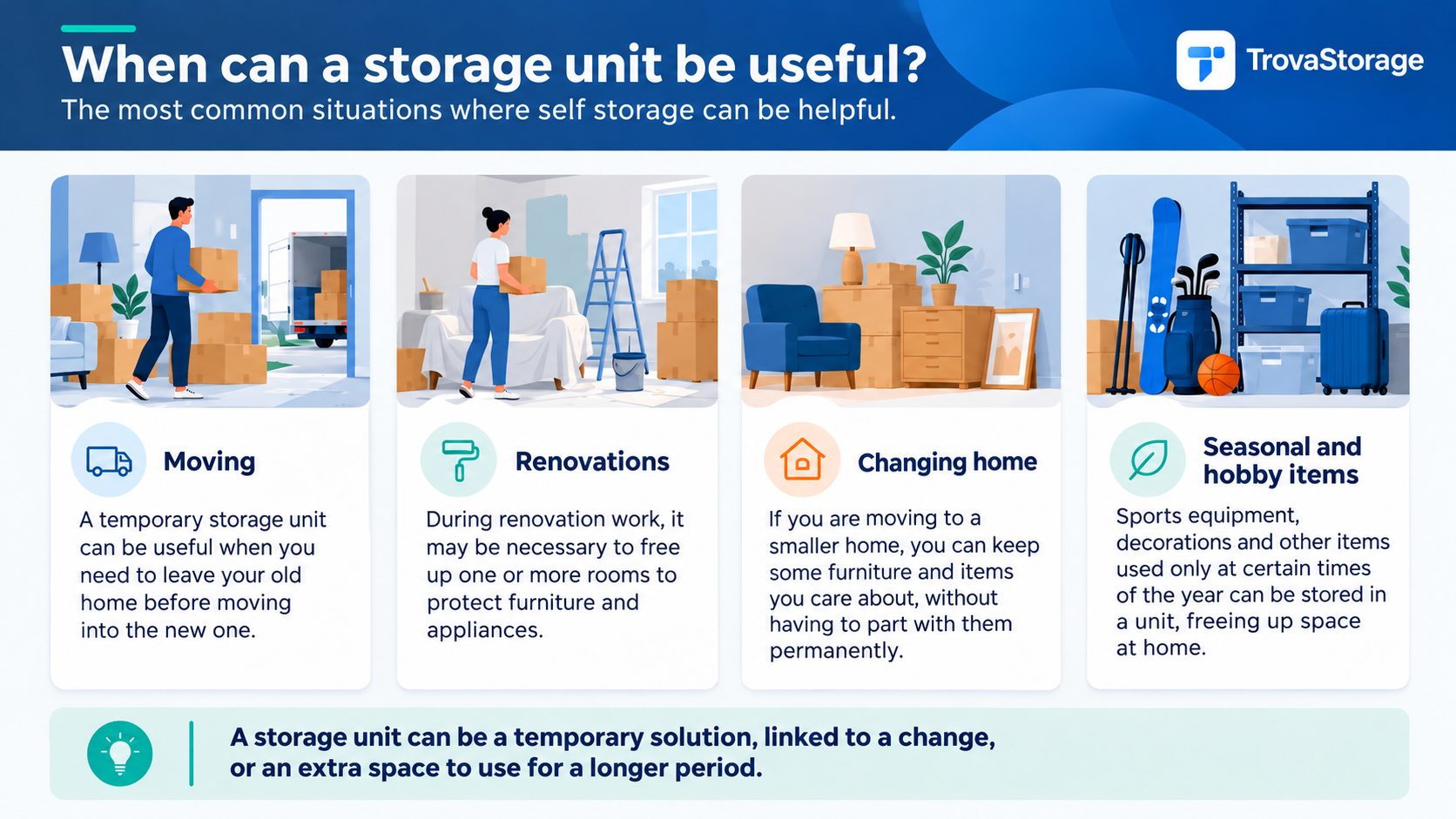
People rarely look for storage because they have "too much stuff". More often, it's the space they need that changes, sometimes overnight.
The most common case is a move where the dates don't line up: you have to leave the old home before you can move into the new one and, for a few weeks or a few months, the furniture has nowhere to go.
Then there are renovations. As long as the work involves a single room, you can move everything into the one next door, for example. But when it involves half the house, the sofa, the bookcases and the appliances, then you need more space!
Other times the change is slower and brings decisions that aren't made in an afternoon:
- you move to a smaller home and don't want to part with furniture that is still in good condition, or that you are attached to;
- you inherit family furniture and don't yet know where to put it;
- you move in with your partner and suddenly you have two sofas, two tables and two of everything;
- you are getting the nursery ready for a baby on the way and the study has to go.
Finally, some people keep a unit all year round, for things they only need in certain seasons: skis, bikes, Christmas decorations, hobby equipment. Especially in a flat without a cellar, it's exactly these items that fill wardrobes and cupboards only to be used a few weeks a year.
A unit can therefore be a temporary solution, tied to a moment of change, or extra space to keep for the long term. Either way, though, it isn't the only option.
Storage unit, garage or furniture storage: what are the differences?
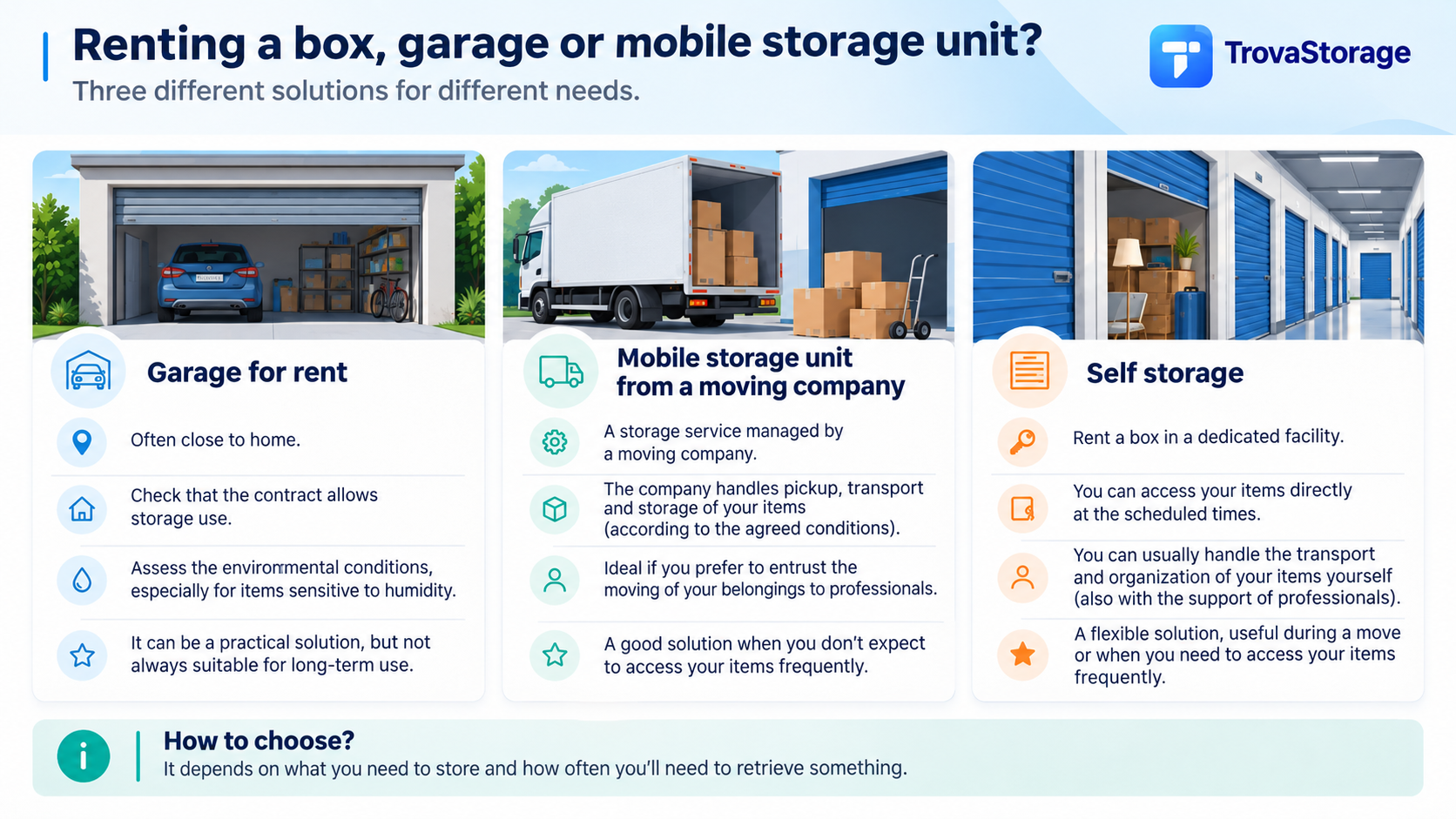
When you are looking for somewhere to put furniture and boxes, there are usually three routes: a rented garage, a moving company's furniture storage or a self storage unit.
A rented garage is convenient if you need space close to home. Before filling it, though, check two things: that the contract allows you to use it for storage and that it is dry. Wooden furniture, mattresses and fabrics suffer from damp more than you might think.
A mover's furniture storage works differently, because you hand everything over to them. Depending on the agreement, the company collects the furniture, takes it to its warehouse and brings it back when you ask for it. It makes sense if you'd rather not deal with the transport and don't expect to need anything back in the meantime.
Self storage, on the other hand, leaves the keys in your hands, or more and more often access from your smartphone. The unit is yours alone, you go in during the facility's hours and take what you need. You usually arrange the transport yourself, but you can still hand it to a removal company.
During a move this independence makes all the difference! When you need your heavy coat or the box with your documents, you drop by and pick it up, without having to ask anyone.
In short: if you want to hand over transport and safekeeping, go to a mover; if you want to reach your things whenever you need them, consider a self storage unit. We go deeper into the comparison, costs included, in the guide Deposito mobili o self storage: differenze e costi, in Italian.
Why is self storage still little known in Italy?
As we told in the second part, self storage spread in the United States from the 1970s, while in Italy the first operators only appeared in the early 2000s. Then the 2008 crisis slowed the sector down, and it picked up again mainly in the big cities.
That delay can still be felt. According to a 2023 European survey of the industry, almost everyone in the United Kingdom knows what self storage is; in Italy, fewer than half of people do.
The Italian market is moving, though. According to the last two editions of the report, in one year the floor area of self storage facilities in Italy grew from about 170,000 to 190,000 square metres. But these are still small numbers compared with the United Kingdom alone, which accounts for more than a third of all self storage space in Europe.
In practice, in the big cities you can compare several facilities, while elsewhere there are fewer of them and they are often further away. And many people dealing with a move think straight away of a garage or a mover, without knowing that a third option exists.
For a more precise picture of the situation in different areas, read our guide: How hard is it to find self storage in Italy today?
How to choose a self storage unit that fits your needs
The first step isn't choosing the size of the unit, but telling the facility what you need to store. Working out the right space is then up to the operator.
When you ask for information, say:
- which furniture and items you want to store, which can be taken apart and whether anything is fragile;
- how long you expect to keep the unit;
- how often you will need to go back.
If you want an idea beforehand, the guide Quanti metri quadri servono, in Italian, helps you estimate it.
Then look at the location. If you'll be visiting often, a facility on the way between the old and the new home saves you a lot of time. Also check that a van can get there easily and that there are trolleys or a goods lift.
Access hours vary a lot from one facility to another. Some let you in outside office hours, others have fixed time slots. Better to know before signing.
If you are storing wooden furniture, books or fabrics, ask how the rooms are protected from damp, what security systems are in place and whether insurance cover is provided.
Finally, the contract: minimum term, how it renews, notice period for cancelling. And when you receive a quote, think in terms of the total price: what is included, and whether there are deposits or extra costs. For a reference point, we cover it in the guide Quanto costa un self storage, in Italian.
Comparing these points across two or three facilities is the simplest way to work out which one is really right for you. If you'd like a step-by-step guide, from choosing to your first day of use, you'll find it in Renting a self storage unit: how to choose the right facility and start using it.
So, from the warehouses of ancient Rome to the orange doors of California, all the way to the units that today open with a smartphone, the way we store our things has changed along with people's homes and habits. The underlying need, though, has stayed the same: a safe place for what no longer fits at home, but that we don't want to give up.
With this third part, our journey through the history of self storage comes to an end.
And if you are now the one looking for space, on TrovaStorage.it you can find facilities in the area you are interested in and send a free, no-obligation request for advice and a quote to up to three facilities. They will reply directly with availability, the most suitable unit, the total price and the terms of the service.