Self storage security: what to check before renting a unit
By Davide Padeletti. Last updated: .
You have planned the move, filled the boxes and found somewhere to leave your furniture in the meantime. Then, just as you are about to take everything to the unit, a doubt creeps in: will it really be safe in there?
It's a perfectly reasonable question, especially if you need to store family keepsakes, personal belongings or furniture you care about.
When choosing a self storage facility, the first things people look at are location, opening hours and price. Security matters at least as much as all of that, though, because you are trusting your things to a place you don't know.
Security systems are the first thing you notice, but on their own they don't make a facility safer. Check who can get in and how, what kind of lock your unit has, what condition the building is in and what happens if there is a fire or a room floods.
No facility can eliminate every risk, and each operator does things its own way. That's why it pays to know what to look for and what to ask before you sign, and above all what you can do yourself to protect your belongings.
What to check first
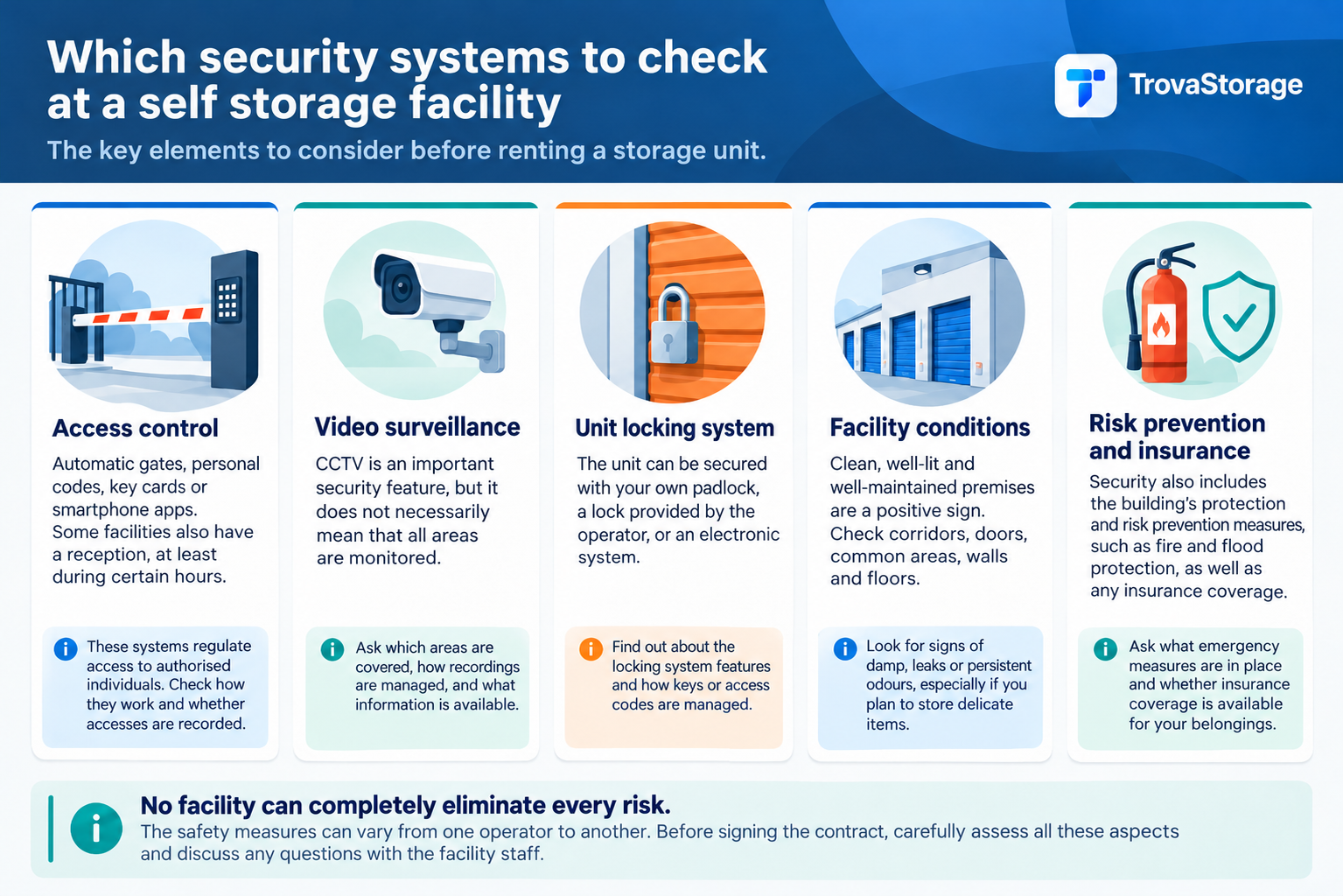
In a self storage facility you rent a private space and go in on your own, during the set hours. That's different from a moving company's depository, where the company usually looks after your furniture and brings it back to you. Precisely because you are the one with access, it's worth understanding how the facility you choose is protected.
Start with the entrances. Some facilities use automatic gates and a personal code, others a badge or a smartphone app, and others have a reception that is staffed at certain times. Always ask how the system works and whether each entry is logged: if something goes wrong, knowing who came in and when makes all the difference.
Then there's video surveillance. Cameras are useful, but they won't necessarily cover every corridor. Ask which areas are filmed and how the recordings are handled. If the operator stays vague on some details, that isn't necessarily a bad sign: some information may not be shared precisely for security reasons.
Check how the unit is locked, too. It could be your own padlock, a lock supplied by the operator or an electronic system. Ask how it works and who manages the keys and codes.
Finally, the building. A secure facility has to protect your belongings from fire and flooding as well as theft. Entrances, cameras, locks, prevention and insurance should be weighed up together: what counts is the whole picture, not any single detail.
What to look for when you visit the facility
Photos and online descriptions are great for a first shortlist. But if you can, go and see the facility in person: that's where your things will be staying, and some impressions only come from walking in.
Take a look around as soon as you step inside. Are the corridors clean and well lit? Are the unit doors in good condition? Are the shared areas tidy and easy to get around? They may seem like details, but they say a lot about how the building is looked after.
A well-kept facility is a good sign, even if that alone doesn't guarantee that the security systems work.
Have a look at the walls and floors as well. Damp patches, leaks or a musty smell should be pointed out to the staff straight away. If you need to store wooden furniture, books or fabrics, damp is enemy number one.
A tip: if possible, ask to see a vacant unit similar to the one you are being offered. That way you can check the door, the floor and the real condition of the space at your own pace.
The visit also helps you understand how the facility is run. If you expect to drop by often to pick things up, ask about access hours and when staff are on site. Some facilities let you in outside office hours, others only at set times.
Insurance and emergencies: what to ask before signing
Some things you won't find out by looking at the corridors, and sometimes you need to ask directly. Of all the questions you could ask, three really matter.
- Who can get into your unit?
- What happens in an emergency?
- If something is damaged, who pays?
Let's start with who can get in. Ask whether you are the only one with the key or code, or whether staff can open the unit in certain situations, such as an emergency covered by the contract.
Then there are emergencies. If a fire breaks out or a room floods, what prevention and alarm systems are in place? Who steps in, and how are customers told? Every facility has its own arrangements, so don't take anything for granted.
And finally, insurance. Be careful not to confuse it with security: security measures are there to prevent damage, while insurance determines whether and how you will be compensated once damage has been done.
Not all facilities offer the same cover. Some include a policy in the price, others offer different options. Before signing, ask:
- which risks are covered and which are excluded;
- what the maximum payout is and whether there is an excess;
- how to report damage and which documents you need to make a claim.
If you want to store valuables, tell the operator clearly and ask whether they are allowed and covered.
One last piece of advice: get everything in writing and read the contract before confirming, so you don't get any nasty surprises once the damage is done.
How to protect furniture and personal belongings in storage
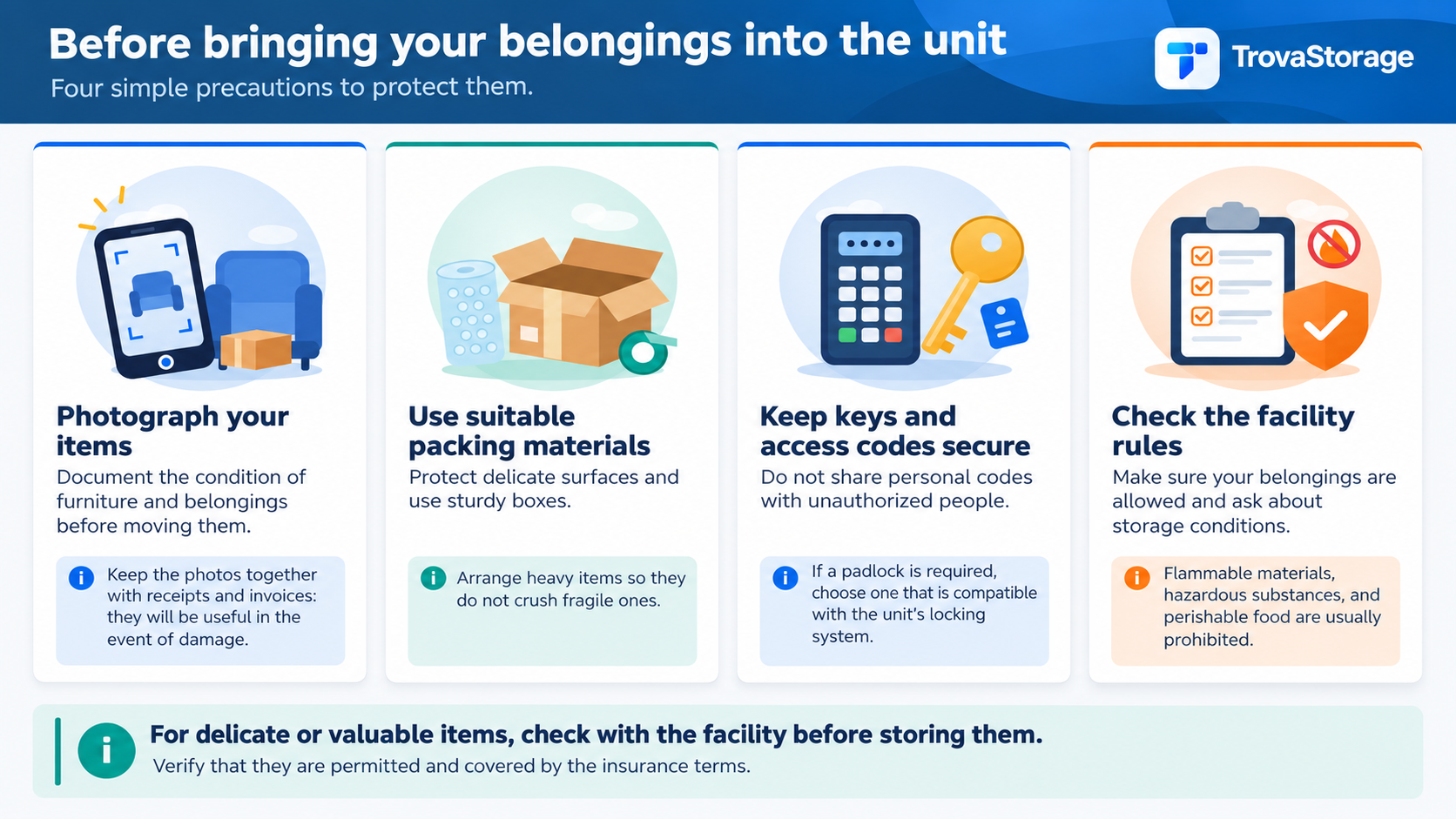
A compliant facility will always do its part, but you can do yours too. If you are asked to bring a padlock, choose one that fits the unit's closure and follows the operator's instructions. Always keep the keys somewhere safe and don't give the access code to anyone who isn't authorised.
Before the move, it's always a good idea to take a few photos of the furniture and items you will be taking to the unit. Together with receipts and invoices, they will help you show what was there and what condition it was in, should anything happen.
Don't neglect the packing. Protect delicate surfaces, use sturdy boxes and arrange heavy items so that they don't crush more fragile ones. For furniture, electronics and sensitive items, follow the appropriate storage instructions and, if in doubt, ask the facility for advice.
Remember that not everything can go in a self storage unit. Flammable materials, hazardous substances and perishable food are usually banned or strictly limited. Every facility has its own rules, and following them protects you as well as the other customers.
For cash, jewellery, original documents and other high-value items, it's better to consider dedicated safekeeping. If you still want to store them, check first that they are allowed and covered by the insurance.
Finally, if you need the unit for many months, it's good practice to stop by and take a look from time to time. A quick visit is enough to spot any problems in time.
Compare several facilities before choosing
The best way to find the right facility is to compare several operators.
On TrovaStorage.it you can search for self storage facilities in the area you are interested in, read the information available and choose the ones that suit you best. You can select up to three facilities and send a free request for advice and a quote, with no obligation.
In your request, tell us what you need to store: which furniture and items, whether any of them are delicate, how long you need the space for and how often you expect to visit. Above all, it's the right moment to ask your questions about security, insurance and storage conditions.
The facilities you selected will reply with availability, recommended sizes, the total price and any extra costs. You'll have everything you need to compare the offers and choose the right place to keep your things.