Students away from home: where to keep your things between Erasmus and moving rooms
By Davide Padeletti. Last updated: .
How much space you really need, how to organise the move and how to choose the right unit before you leave.
Your Erasmus is confirmed, the flight booked, the room given notice on, but then you look around and see all the books piled up over three years, the frying pan (the good one!), your winter clothes, the bike, that bookcase you put together with so much effort. A tenth of it fits in your suitcase. And the rest?
“I could take everything back to my parents' place”. Yes, that makes sense if you live half an hour away, though. But if you are 800 km away and in six months you will be back in the same city, you end up doing two long moves just to put things back where they were!
The same problem comes up when the contract for your old room ends in late June and the new one starts in September. Or when your university residence asks you to clear your room for the summer.
In this guide we will give you a few tips and look at when you really need storage, how to organise the move before you leave and how to choose self storage that suits a student living away from home: a private space inside a dedicated facility, where you leave your things and come back to collect them when you need them.
When a student living away from home needs storage
There are generally three typical situations:
You are leaving for Erasmus. Months abroad mean months of rent for an empty room. If your contract allows it, you can decide to give it up. When you come back, though, you will need your things there again, in the city where you study.
You are changing rooms. The old contract ends, the new one has not started yet. For a few weeks, books, clothes and boxes have nowhere to go.
Summer arrives. Some university residences reassign rooms over the summer months and ask you to clear them completely. If instead you have an ordinary tenancy that is still running, going on holiday does not oblige you to empty your room.
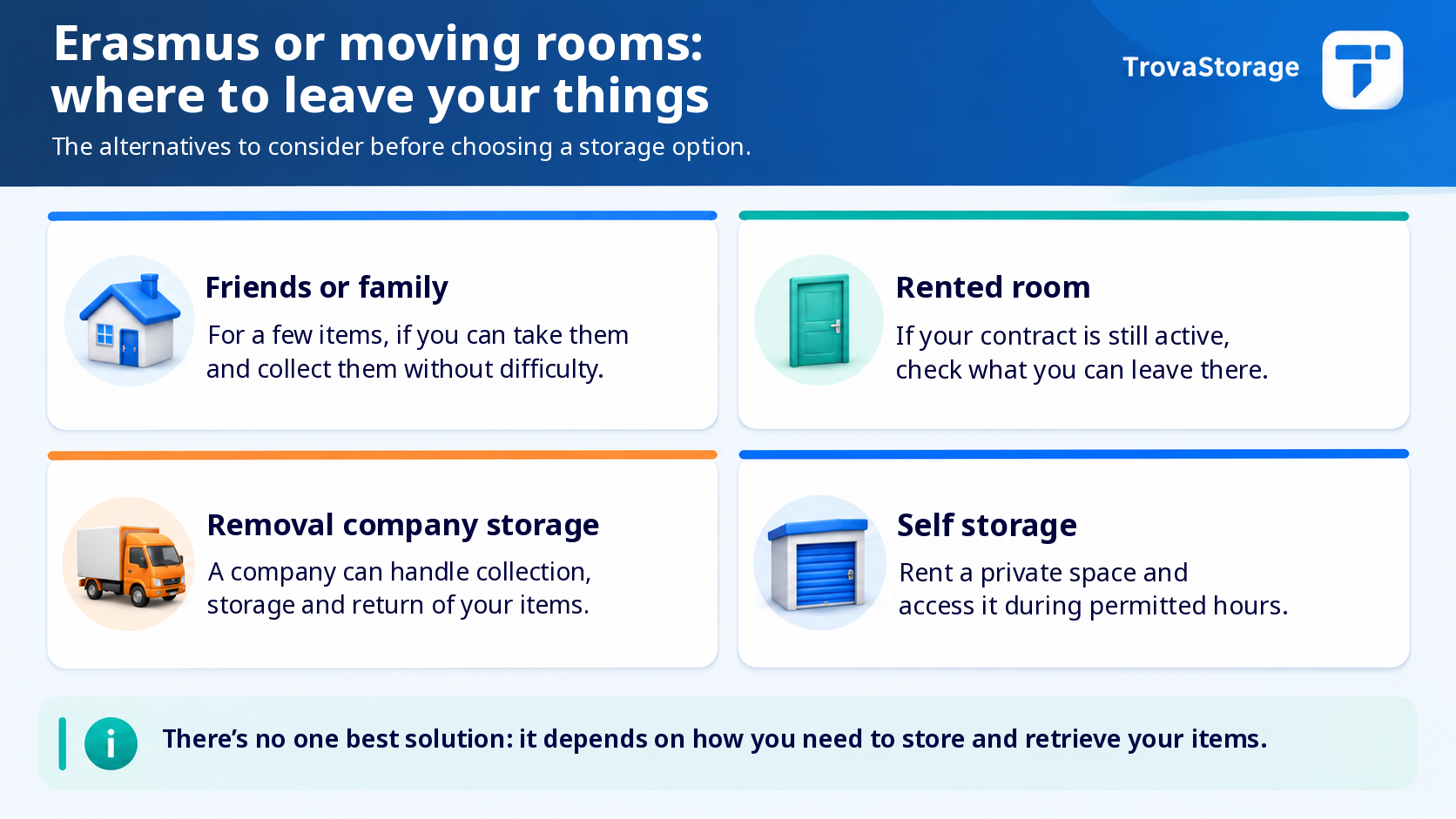
Self storage is not the only option. If you have only a few things, a friend's cellar or a lift to your parents' place is more than enough. If you would rather someone loaded, transported and looked after everything for you, there is a removal company's storage, often with collection and return included. Self storage sits in the middle: the space is yours, you bring your things yourself and, if you need something halfway through the semester, you can drop by and pick it up.
A real example: Laura and her six months in Valencia
Laura studies in Bologna and in February she leaves for six months of Erasmus in Valencia. Her room, in a shared flat, is about 18 m². Besides the landlord's furniture, it holds around ten boxes of books, winter clothes and kitchen things, a desk that can be dismantled, a shelving unit and the bike.
It looks like a lot. In fact, as a rule of thumb, the contents of a 15–20 m² student room fit into a unit of about 2–2.5 m². To give you an idea: a 1 m² unit holds about 15 standard boxes, a 2 m² one roughly twice as many.
As a rough guide:
- boxes only (6–8, books and clothes): a small unit or a locker of about 1 m³ is enough;
- half a room, with some furniture: about 1.5 m²;
- a whole room, with desk, shelving unit, boxes and bike: about 2–2.5 m².
So Laura needs a unit of about 2 m². Before deciding, she compares the quote with six months of rent for an empty room, which in the main university cities costs several hundred euros a month. When she comes back she finds everything in the city, a few kilometres from her new home.
We have used approximate sizes. Each facility will confirm the right ones for you, based on what you need to store.
How to organise the move before you leave
Between exams, last lectures and Erasmus paperwork, the move always ends up at the bottom of the list and turns into a real problem.
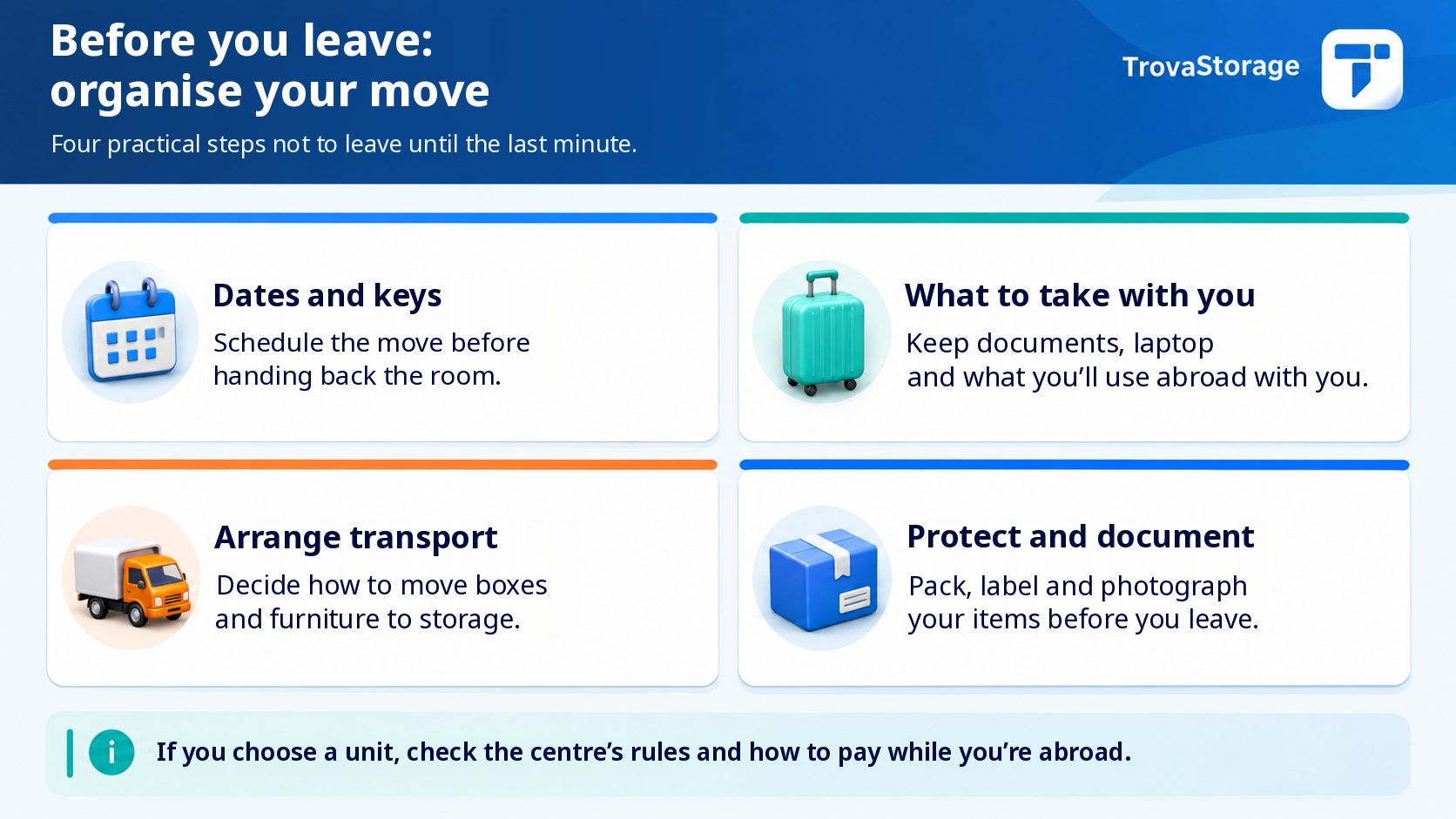
Start from the date you have to hand back the keys and work backwards: the move should be done a few days before, not on the last evening.
Then split everything into two piles: what goes with you and what stays. Documents, laptop and clothes for the right season go in the suitcase. Books, pans, spare sheets and everything you will not use abroad go into storage.
The last step is transport: if you do not have a car you will need to ask a friend or acquaintance, or book a rental or a professional service. And do not take it for granted that the self storage facility handles this too: some offer it, others do not, so it is always best to ask first.
The checklist before you leave
- Note the date you hand back the keys and schedule the move a few days earlier
- Separate what you are taking abroad from what goes into storage
- Check which furniture is yours and which belongs to the landlord
- Ask for quotes and book the unit
- Arrange the transport
- Pack and label the boxes, then photograph everything
- Set up the payments for the unit for the months you will be abroad
How to choose self storage as a student living away from home
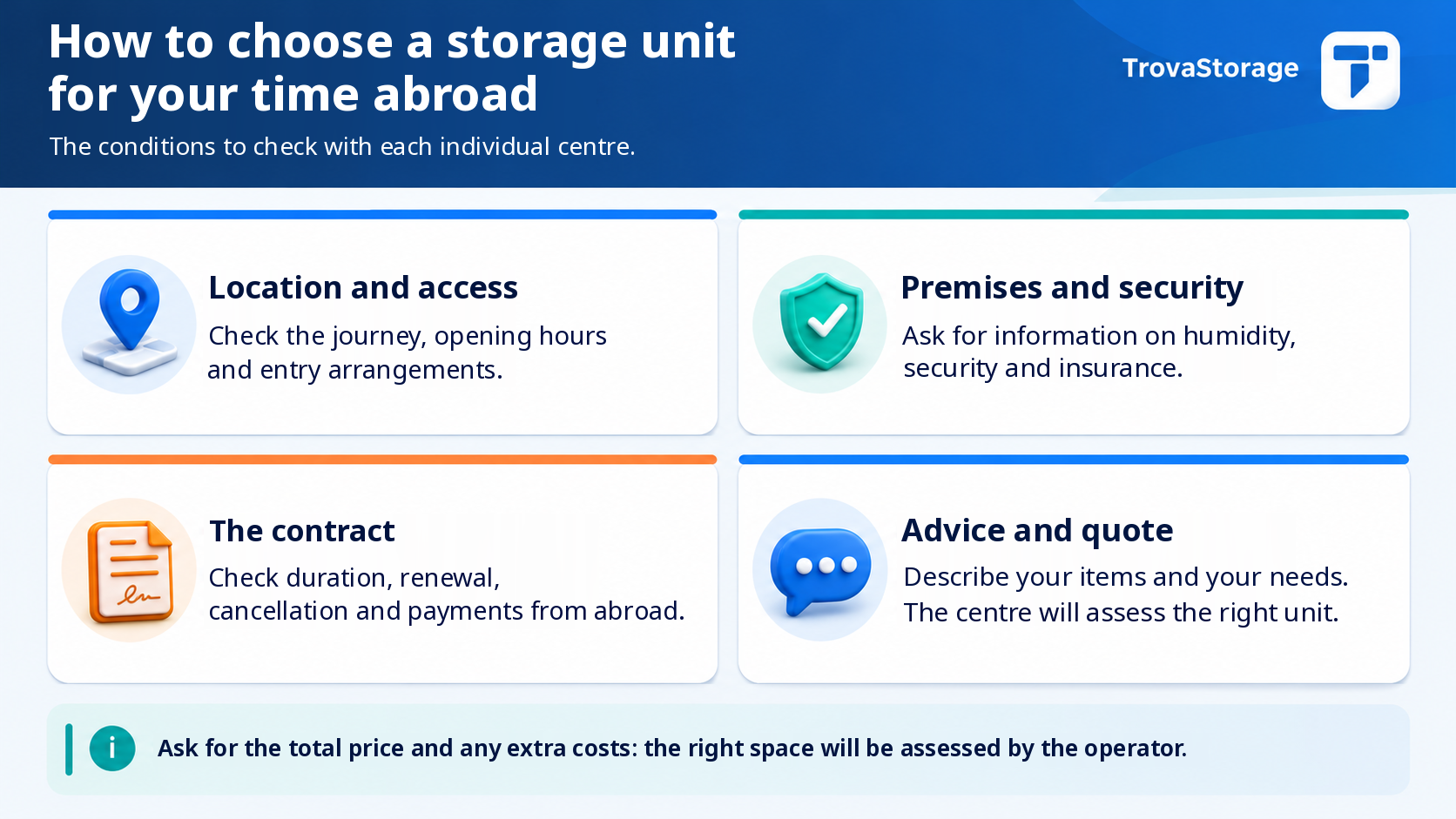
Location. If you are coming back to the same city, choose a facility that is easy to reach from the area where you will look for a home: on the day you return it will make all the difference. If you do not know yet where you will live, allow for a second move, perhaps to another city.
Access hours. Some facilities can be accessed in the evening and at weekends too, others have fixed time slots. Check that they fit with your departure and return days, which are exactly the ones when you will have the least leeway.
Humidity and security. Books and clothes suffer from humidity more than you might think. Ask what the premises are like, what security systems are in place and whether insurance cover is provided for the stored items.
The size of the unit. You do not have to work it out yourself: just describe to the advisor what you want to store (boxes, furniture that can be dismantled, bike, fragile items), for how long and how often you expect to drop by. They will tell you the right space and prepare a quote for you.
The contract. If you are leaving for Erasmus, this is the part to read most carefully: minimum term, renewal, notice period for cancelling. And above all, how you will pay while you are abroad. Better to clear it up now than to find out from Valencia.
Sharing the unit. Sharing the unit with your flatmates lowers the cost, but it needs organising. Agree with them on whose name the contract goes in and how to split the costs, then ask the facility whether other people can be authorised to access it, because not all of them allow it.
The quote. Look at the total price, not just the monthly rate: included services, any deposit, insurance and extra costs can change the final bill considerably.
How to prepare your things so you can find them when you return
After six months away, remembering which box the sheets ended up in is not a given. A few extra minutes now will save you an afternoon of searching later.
Use sturdy boxes and do not overfill them, especially with books and pans. Wrap plates and glasses, and never put them under the heaviest boxes.
Write clear labels on several sides: «university books», «kitchen», «winter clothes». Before closing them, take a few photos and keep a list on your phone.
One thing to know before you load up: perishable food, flammable substances and other hazardous materials are usually prohibited or restricted. Original documents, cash and valuables are also best kept elsewhere. Each facility has its own rules, so always ask for the list of what is allowed.
Frequently asked questions
How much space do you need for the contents of a student room? Usually from 1 to 2.5 m². If you only have boxes, a small unit is enough; for a whole room with desk, shelving unit and bike you need about 2–2.5 m². The facility will confirm the size based on your list.
How much does self storage for students cost? It depends on the city, the size of the unit and the duration. The quickest way to find out is to ask for a quote.
Can I share the unit with my flatmates? Often yes, but it depends on the facility. Agree on whose name the contract goes in and ask whether other people can be authorised to access it.
Can I pay for the unit while I am abroad? Payment arrangements vary from facility to facility, so ask before signing and sort everything out before you leave.
What can't I put in the unit? Usually perishable food, flammable substances and hazardous materials. For original documents, cash and valuables, a different kind of safekeeping is better.
Find the right storage in your university city
On TrovaStorage.it you can search for self storage facilities in the city where you study and compare the information available.
Choose up to three facilities and send a request for advice and a quote, free and with no obligation. Describe what you need to store, for how long and how often you expect to drop by: the operators will reply to you directly, with availability, unit size, total price and the terms of the service.
That way you leave with the right suitcase and a clear head. And when you come back, your things are there, waiting for you.