Self storage in Italy and Europe: where things stand
By Davide Padeletti. Last updated: .
In Europe it is a mature sector, in Italy it is growing right now: figures, new investors and what changes for anyone looking for a unit.
You have found a home, but the work will not be finished for another two months. Or you are renovating, and the sofa, the wardrobe and twenty or so boxes no longer have anywhere to go. In both cases the question is the same: where do I put everything in the meantime?
One possible answer is self storage. It works like this: you rent a locked unit inside an equipped facility, bring your things there and come back whenever you need them, on your own, during the facility's opening hours.
In many European countries it is a solution people have used for decades. In Italy, on the other hand, few people know about it yet, even though the sector has grown in recent years and major investors have arrived. Facilities, however, are not evenly spread: in a big city you can compare several operators, while in smaller towns the choice is sometimes more limited.
So let's look at where the market stands, in Europe and in Italy, and what it actually changes for anyone looking for a unit.
In Europe: a mature market, but not the same everywhere
Modern self storage reached Europe in the 1980s, starting in the United Kingdom, and from there it gradually spread to other countries. If you are curious about how it happened, we covered it in the second part of our history of self storage.
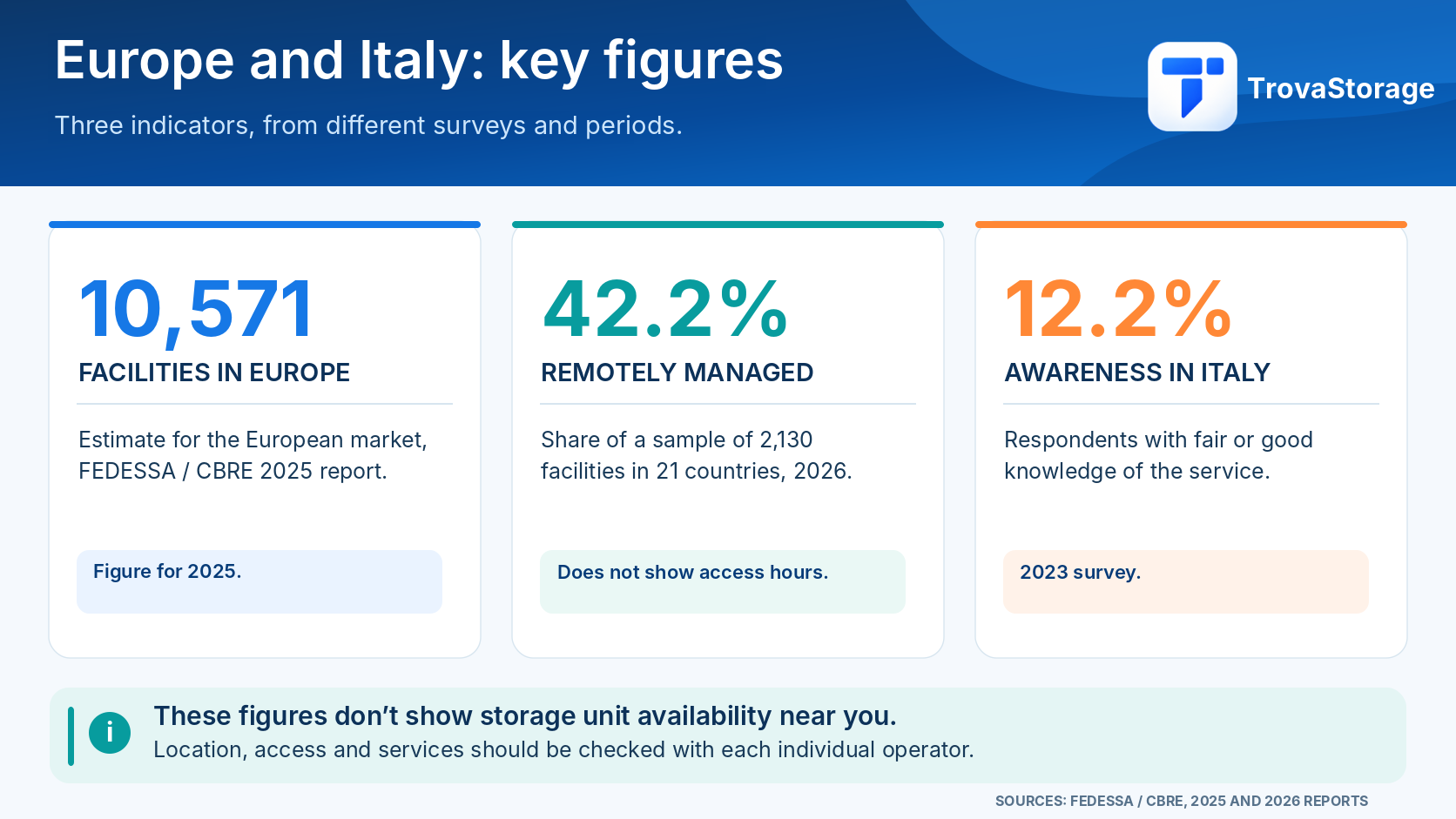
Today it is an established sector in several countries. According to the 2025 FEDESSA and CBRE report, there were about 10,571 facilities in Europe, with a total of 17.7 million square metres. Four countries take the lion's share: the United Kingdom, France, Germany and Spain alone account for 68% of facilities and 75% of available space [1].
The 2026 report came out in September and confirms the growth [2]. With one caveat: for the distribution of facilities across countries, it reuses the previous year's data, updated only where national associations supplied new figures. So it is not a new, complete census.
More than in the figures, what is new is the way facilities are run. Bookings, contracts and access increasingly go through digital tools: in the FEDESSA 2026 survey, which covered 2,130 facilities in 21 countries, 42.2% were managed remotely [2].
Digital management, however, does not necessarily mean access by smartphone, nor entry at any hour. Some highly tech-driven facilities keep traditional opening hours, and others still work the old-fashioned way. When you choose, what really matters is knowing when you can get in and how the service works in practice.
Finally, even where self storage is widespread, not everyone knows it well. And Italy is one of the countries where this gap shows the most.
In Italy: a sector that is still growing
Here, modern self storage began to spread between the late 1990s and the early 2000s, and the market has developed more slowly than in the United Kingdom and other European countries. Facilities are found mainly in large urban areas such as Rome and Milan; in smaller cities, and in some parts of the country, the choice can be limited.
A few figures help put things in proportion. According to FEDESSA, Italy has about 190,000 square metres of self storage: Spain has about 2 million, the United Kingdom more than 6 million [1]. When it entered our market, Safestore estimated that Italy had about two facilities per million inhabitants, with space per inhabitant at about a fifth of the European average: the lowest in Western Europe [3].
There is, however, no official count of all Italian facilities: the FEDESSA reports give the floor area, but not the number of sites [1][2]. Working it out from Safestore's estimate, the total comes to around a hundred across the whole country.
Awareness of the service is also still low. According to the 2026 FEDESSA and CBRE report, only 12.2% of Italians surveyed said they knew self storage fairly or very well [2]. The figure comes from a survey carried out in Italy in 2023 and quoted in the report, but it conveys the picture well.
This is also why, when furniture has to be put somewhere during a move, many people first think of a relative's garage or the removal company's storage. The idea that you can rent a unit all to yourself, and manage it on your own, is still not that widespread.
Then there is a figure that is surprising at first sight: according to the same 2026 report, the average occupancy of the Italian facilities analysed fell to 64.3%, about 13 points lower than the year before. Before reading it as a sign of crisis, it is worth looking at the sample: across Europe it grew from 1,431 to 2,130 facilities and includes several recently opened sites, which are obviously not full yet. The report itself warns that changes in individual countries should be taken as indicative [2].
Why major investors are looking at Italy
In recent years, Italian self storage has attracted some big names in international real estate. Three deals in particular illustrate the trend well.
In December 2024 Safestore and Nuveen set up a 50/50 joint venture to acquire Easybox, Italy's second-largest operator by number of facilities, for 175 million euros. At the time of the deal Easybox had 10 facilities in operation and 2 under construction, across Milan, Turin, Rome, Genoa and Florence [3]. For Safestore, it was a way into our market starting from a company already well established locally.
In October 2025 came H.I.G. Capital, which launched a new Italian platform, Boxengo, starting from five sites: four in Milan and one in Rome, with openings planned between late 2025 and 2026 [4].
Finally, in March this year it was the turn of Ardian, which announced an agreement to acquire a majority stake in Casaforte, Italy's leading operator: 24 facilities and about 80,000 square metres, mostly in the North. The deal is part of the group's wider strategy for European self storage [5].
The reason for so much interest is fairly simple: compared with other European countries, Italy still has few facilities, so there is still plenty of room to grow.
That said, the arrival of a large group does not mean a facility will open round the corner from you tomorrow. Opening a site takes time and depends a great deal on the local area. And alongside the large operators, many local and independent businesses keep working. More operators mean more alternatives, but each facility still has to be judged on what it offers.
What changes for you, if you are looking for a unit
The market is moving, but when you have a move or a renovation ahead of you the problem stays very concrete: finding a suitable place to put your things. More facilities mean more choice, not necessarily an easier choice.
Self storage lets you go and collect your things whenever you need them during the storage period, arranging the transport and the packing yourself. If you want to look more closely at the differences, you will find everything in our guide to furniture storage and self storage.
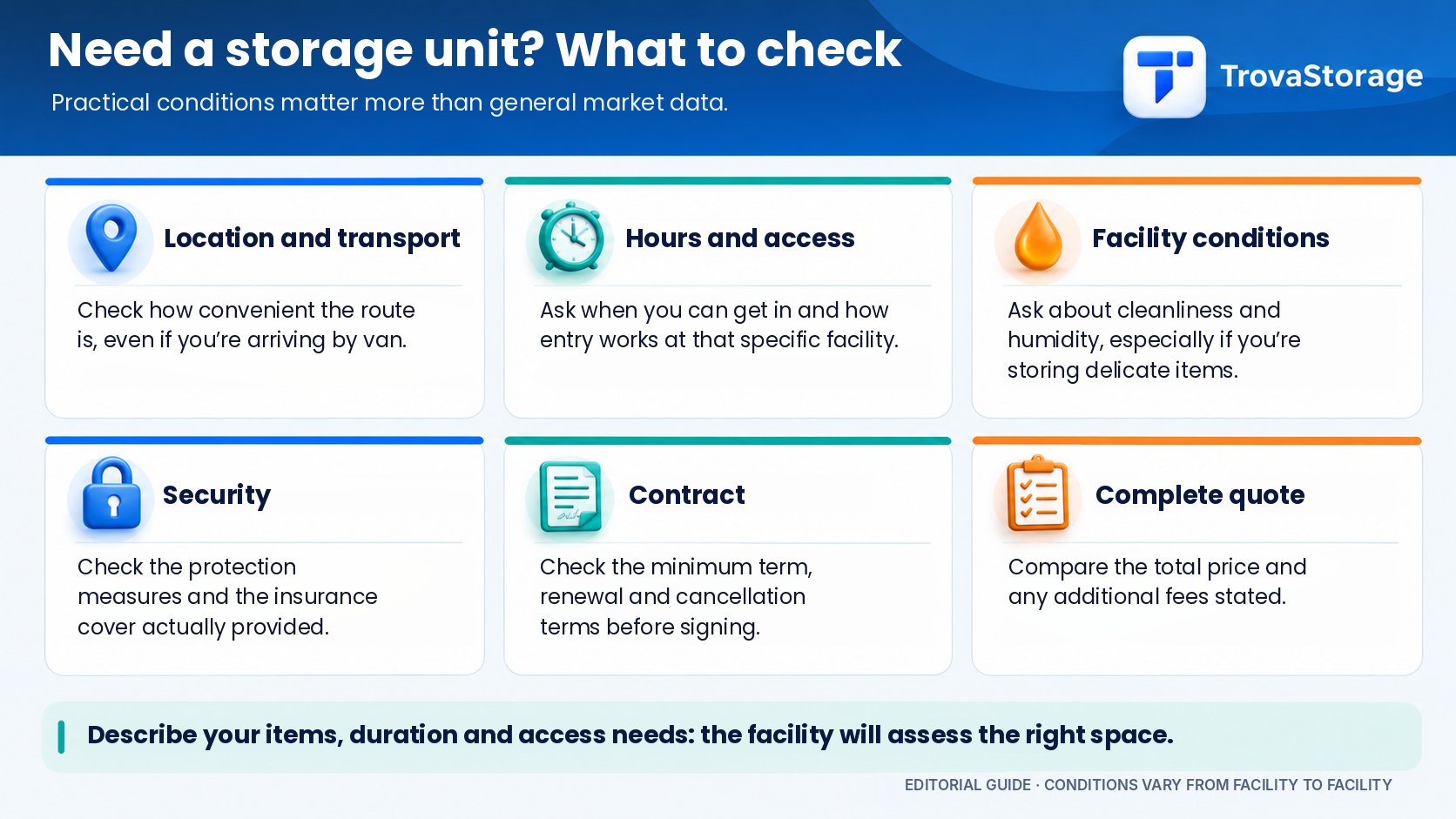
When you compare the facilities in your area, here is what to look at:
- Location: how convenient it is to get there, including by van.
- Access hours: when you can get in, on weekdays and at weekends.
- Conditions of the premises: cleanliness, humidity, temperature.
- Security: video surveillance, access control, alarms.
- Contract: minimum term, renewal and how to cancel.
- Total price: not just the monthly fee, but any extra charges too.
You do not need complicated calculations to work out what size of unit you need. Just tell the advisor what you need to store: furniture, boxes, things that can be dismantled, delicate items. Also tell them how long you expect to keep them there and whether you will need to go often. They will assess the right space and offer you a tailored solution.
On TrovaStorage.it you can search for self storage facilities in the area you are interested in, see the information available and choose which ones to contact. You can select up to three and send a request for advice and a quote, free and with no obligation. The operators will reply to you directly, with availability, the recommended unit, the total price and the terms of the service.
Sources
- FEDESSA and CBRE, European Self Storage Industry Report 2025 (October 2025)
- FEDESSA and CBRE, European Annual Industry Report 2026
- Safestore, Safestore to enter Italy (24 December 2024)
- H.I.G. Capital, H.I.G. Capital Establishes Self-Storage Platform in Italy (14 October 2025)
- Ardian, Ardian signs agreement to acquire majority stake in Casaforte (10 March 2026)