Self storage insurance: what it covers and what to check before renting a unit
By Davide Padeletti. Last updated: .
You have found a self storage facility that is easy to reach, the quote looks good, but just before signing a doubt creeps in: if the sofa gets damaged or someone empties the unit, who pays?
Well… it usually depends on three things: how the damage happened, what your contract with the facility says and what the insurance really covers.
Having a policy is not, on its own, a guarantee of a refund. And even the best-equipped facilities, with video surveillance and controlled entrances, cannot rule out every risk: theft, fire and flooding can happen anywhere.
In this article we look at what to ask and what to read before signing, so you don't find out on the day you open the unit to a nasty surprise.
Is insurance included in the contract?
The simple answer: not always, and it doesn't work the same way everywhere! Some facilities include basic cover in the rent, others offer it separately, and others ask you to have your own insurance on the stored goods. Whether you can use a personal policy instead of the facility's one depends on the facility's rules.
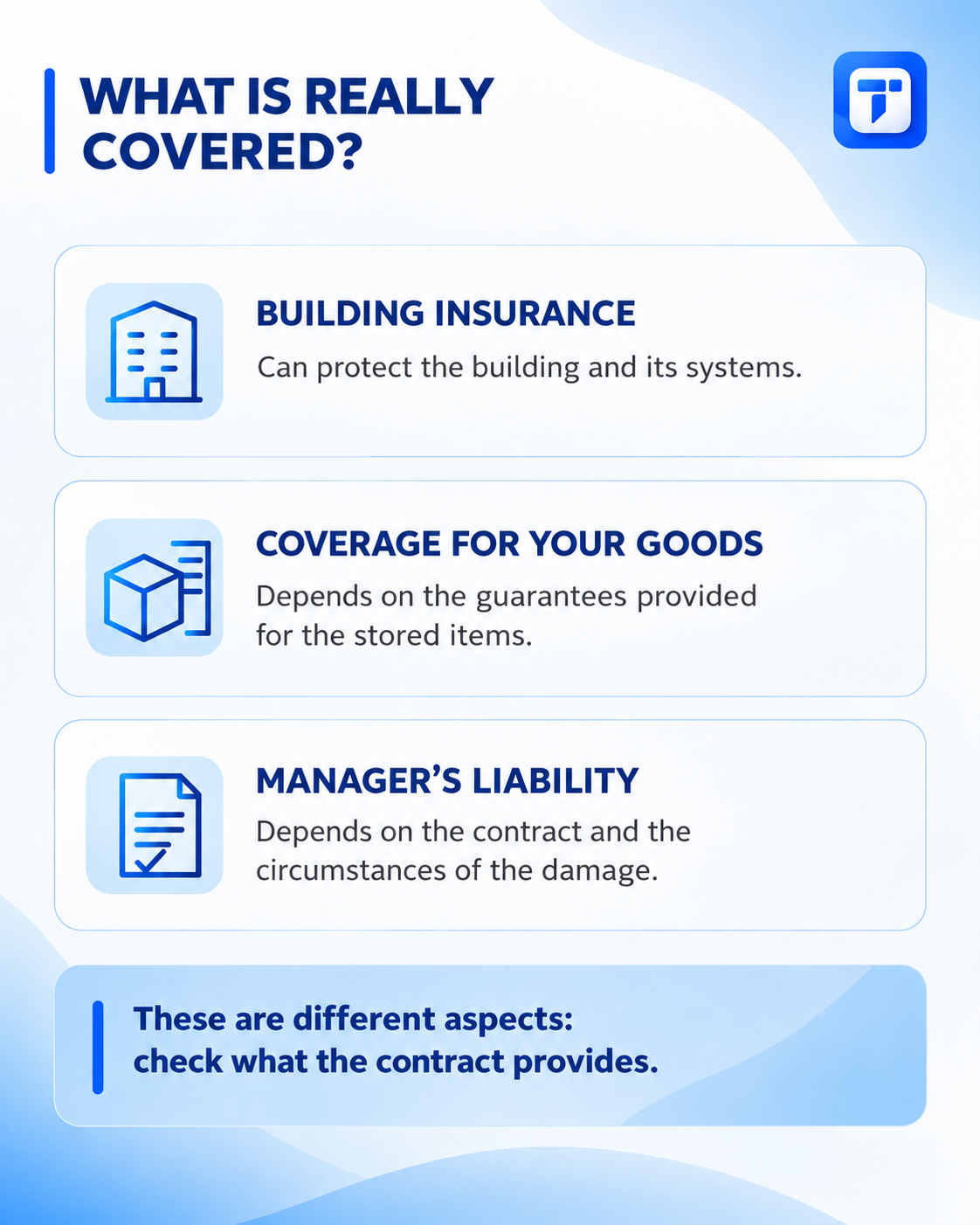
There is also a common misunderstanding: the fact that the building is insured does not mean your belongings are too. The facility's policy may cover the walls, the systems and the operator's liability without saying anything about your wardrobe.
The quote usually has just a short line, something like "insurance included". That is not enough: ask for the full terms and check who the insured party is (you or the facility?), which goods are covered, what the cover costs and who handles the claim if something happens. Read on and you'll find all the right questions to ask in the checklist at the end of the article.
What unit insurance covers (and what it doesn't)
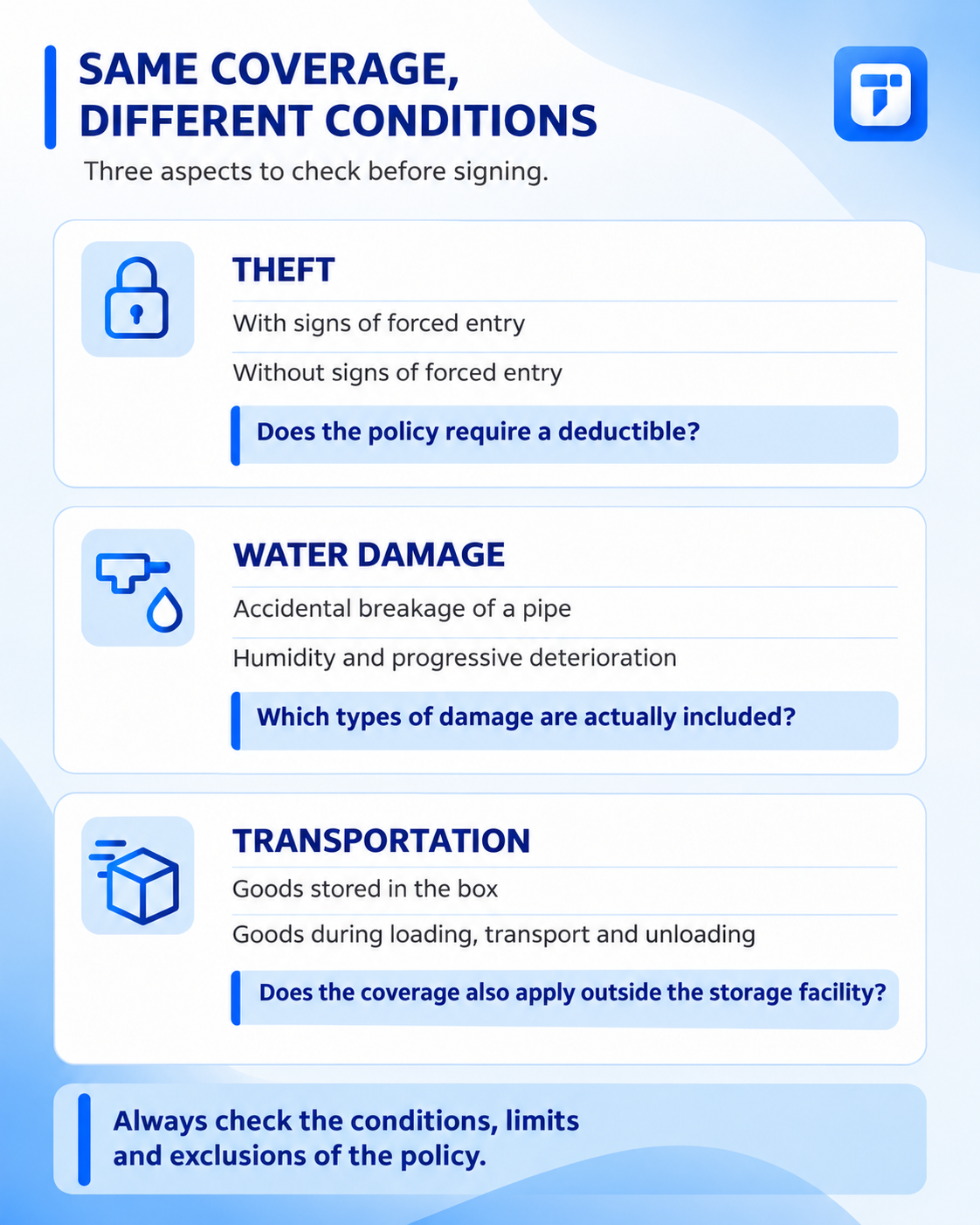
Self storage policies usually cover fire, theft, weather events and water damage. But the names of the guarantees can be misleading.
Take theft, for example: many policies only pay out if there was a forced entry. If the padlock is intact, you risk getting nothing back. The same goes for water: the guarantee often covers a burst pipe, much less the damp that over six months makes a sofa go mouldy or a wooden cabinet swell. If you need to store wooden items, books, fabrics or electronics, this is exactly the condition to check.
And what about the move itself? With self storage you usually arrange the transport yourself, and the policy on the contents of the unit generally doesn't cover what breaks during loading, unloading or the journey. If you use a removal company, ask them how they are insured.
How much you actually get back
Even when the damage is covered, the refund has limits. These are the main terms you may find in the policy conditions:
- Sum insured: the value of the goods stated in the contract. Keep it as realistic as possible: if it is much lower than the real value, the refund may be reduced proportionally.
- Limit of indemnity: the maximum amount the insurer pays for a given type of damage.
- Deductible: a fixed amount you always pay yourself.
- Percentage excess: like the deductible, but calculated as a percentage of the damage.
- Exclusions: the events and items the policy does not cover.
A practical example: a sudden flood ruins some of your furniture. With a deductible you receive the value of the damage minus that fixed amount; with a percentage excess you receive the damage minus a share of it. But if the water guarantee has a limit lower than the damage, you will never receive more than the limit, however large the damage.
And remember that these limits may apply to the whole contents, to a single guarantee or to certain categories of items: electronics, for example, often have a separate cap.
Does your home insurance cover the unit too?
Maybe. Some home insurance policies also cover belongings temporarily taken out of the home, but it's best not to take it for granted: a rented unit is a special case, and the limits for goods kept away from home are often lower.
Before taking out new cover, call your insurer or your agent. Explain where you will take the furniture, what you will store and for how long, then ask whether the policy also applies to a self storage unit, with what limits, and whether you need to report the move in advance. If the answer is yes, compare it with the cover offered by the facility and see which risks each one covers.
Be careful, though: having two policies does not mean getting paid twice. Article 1910 of the Italian Civil Code states that if you insure the same risk with more than one company, you must notify all of them, and that in the event of a loss you cannot receive more in total than you lost. So if two policies cover the same goods for the same events, inform both companies.
How to protect your belongings

Insurance steps in afterwards; precautions prevent the damage in the first place. Always use sturdy packaging, protect corners and fragile parts and, if the unit allows it, keep boxes raised off the floor.
Before the move, take photos of the furniture and items you will put into storage, to record their condition. Note what is in each box and keep receipts and invoices. If something goes wrong, this is what proves what was there and what state it was in.
Valuables need separate thought. Cash, jewellery, works of art and original documents are often excluded from policies, and sometimes the facility's rules don't allow them at all: for those, consider a safe deposit box. And for family keepsakes there is a simple rule: no refund can ever replace them!
What to do if you find damage
It's worth clarifying this part before signing: who should damage be reported to, which documents are needed and by when must the claim be made?
If something happens, remember to:
- Notify the facility and the insurer straight away, following the procedure set out in the contract.
- Photograph the damage, if you can do so safely, before moving or throwing anything away.
- In case of theft, report it to the police: insurers usually require it.
- Keep everything that helps reconstruct what happened: messages and emails with the facility, the date you discovered the damage, the names of anyone who was present.
Bear in mind that there are two separate questions: whether the facility is liable for the damage (for example because of a fault or negligence in the building) and whether the insurance refunds you. The first depends on the contract and the circumstances, the second on the policy conditions. In doubtful cases, or when the amounts are significant, it's worth getting professional advice.
Checklist: what to ask before signing
If you've read this far, you already know that "insurance included" can mean very different things from one facility to another. We've gathered everything into a few questions to ask the facility, and a couple for your insurer: save them on your phone or print them, and before signing make sure you have a clear answer to each one.
- Is insurance included, optional or mandatory? How much does it cost?
- Who is the insured party: me or the facility? Who handles the claim?
- Which events are covered? Does theft count without signs of forced entry? Is damp included?
- What are the sum insured, the limits, the deductibles and the excesses?
- Which items are excluded from the policy or prohibited by the facility's rules?
- Can I use my own policy instead of the facility's?
- Does my home insurance also cover the belongings in the unit?
- In case of damage, who do I report it to, with which documents and by when?
Compare facilities on insurance too
When you choose a self storage facility, price is not the only criterion: what happens if something goes wrong matters too. On TrovaStorage.it you can search for facilities in the area you are interested in and request a free, no-obligation quote from up to three facilities.
In your request, describe what you need to store (pointing out any delicate items), for how long and how often you expect to visit the unit, and ask explicitly what insurance cover they offer. The facilities will reply with the right space, availability, the total price and any extra costs, insurance included.