Self storage in the United Kingdom: how Europe's largest market grew
By Manfredi Miraula. Last updated: .
Self storage in Europe: five countries, five stories. Part 1
Moving house, renovating, relocating for work or ending up with furniture that no longer fits in the flat. These are common situations, in the United Kingdom too.
The difference from Italy is that, for many Britons, self storage is by now a familiar service, something to consider when extra space is needed. Self storage lets you rent a private unit inside a dedicated facility, where you can keep furniture and personal belongings and access them on your own during the permitted hours.
In the United Kingdom this business has grown to become the largest self storage market in Europe.
But its history says more than the simple growth of a sector: it shows how a service that was at first unfamiliar can become part of people's habits.
From the first storage facilities to a network across the country
Modern self storage was born in the United States and began to spread in Europe in the 1980s, starting precisely in the United Kingdom. Over time, the first ventures were joined by national operators, international groups and independent businesses.
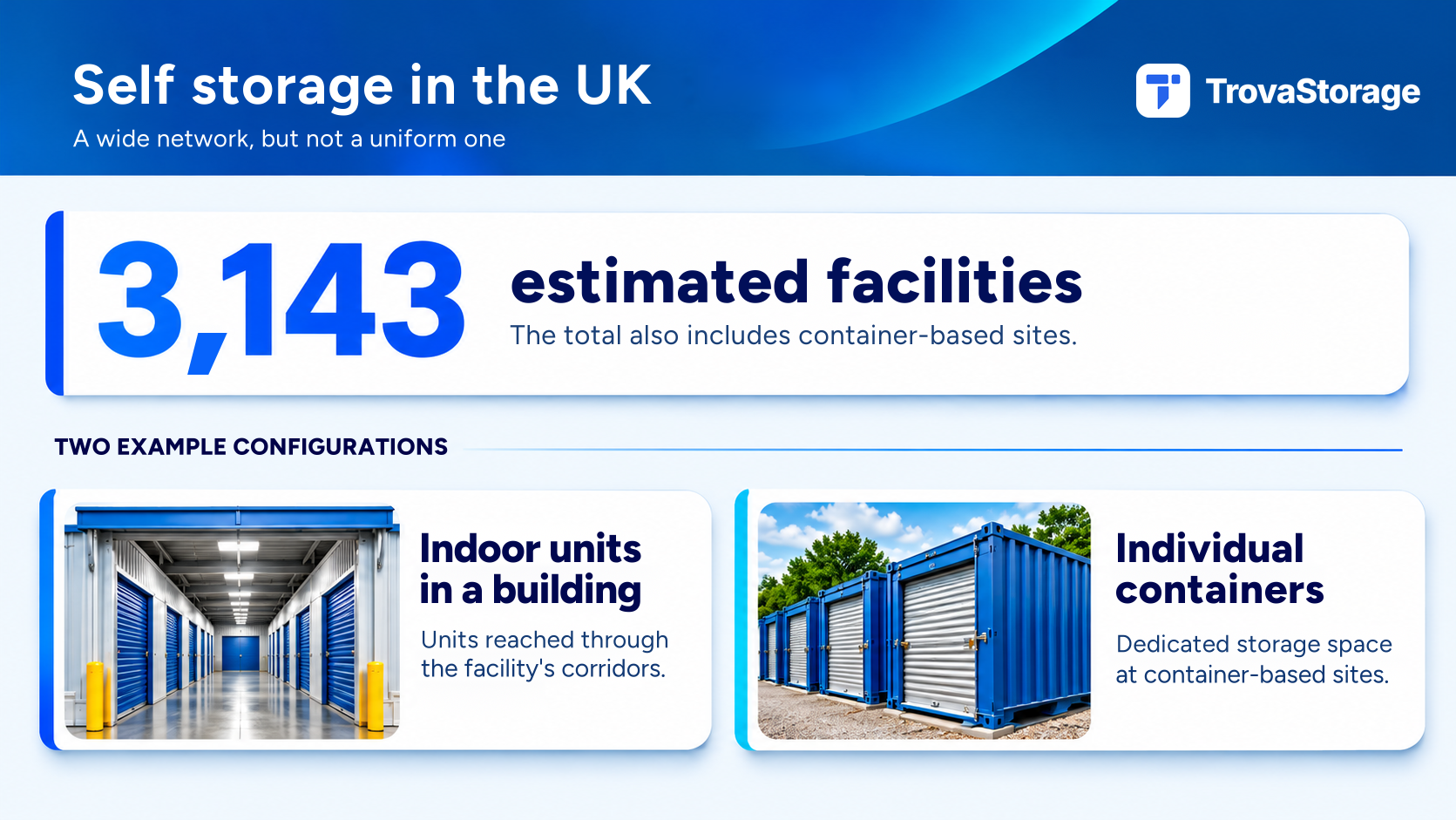
Today, according to the UK Self Storage Annual Report 2026 [1] by the Self Storage Association UK, produced with Cushman & Wakefield, the country has around 3,143 facilities, including those based on individual containers. The report, published this year, mainly analyses operating data for 2025, and the number of facilities is an estimate for the whole British market, not only for the facilities that took part in the survey.
It is a wide network, but not an evenly distributed one. In the main urban areas, the presence of several operators makes it possible to compare different facilities; in less densely populated areas, different solutions may be available, including those that use containers.
The market includes well-known brands, such as Safestore, Big Yellow and Shurgard, alongside many independent businesses. Some facilities are close to residential areas, others in areas that are easier to reach by van. Opening hours, access arrangements and additional services also vary from one facility to another.
For someone who needs to store furniture during a move, for example, this means being able to weigh up not only whether a unit is available, but also how convenient it is to use for their own needs.
Who uses self storage in the UK?
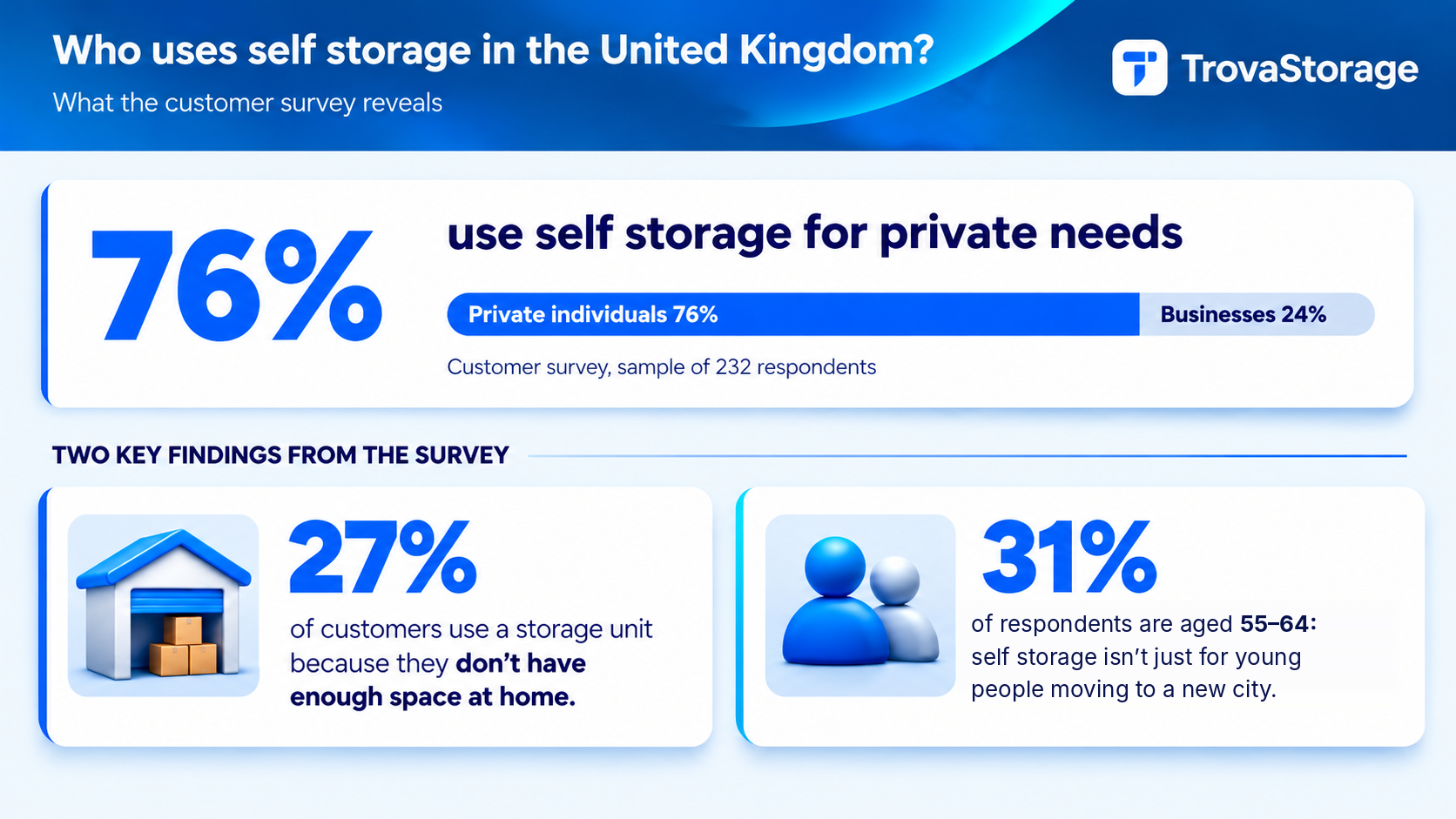
In the survey of British customers included in the SSA UK 2026 report, around 76% of respondents used self storage for private needs (business customers account for only a quarter). The figure comes from a sample of 232 respondents and is not a census of everyone who uses the service in the United Kingdom.
The reasons are the most common ones: more than one customer in four, around 27%, say they use a storage unit because they do not have enough space at home. A unit can also help when the dates for leaving the old home and moving into the new one do not match, or during a renovation, to clear the rooms affected by the work.
Then there are less predictable situations: a separation, having to clear out a relative's home, or moving into a home that is already furnished. In these cases, storing some belongings temporarily can give you the time you need to decide where to put them.
In the survey, 31% of respondents were also aged between 55 and 64. This is a significant part of the sample, though not a majority, and it suggests that self storage is not only for young people who often change city. It can also meet the needs of people who are downsizing their furniture or entering a new stage of life.
When even a mature market keeps changing
Self storage's long presence in the United Kingdom does not mean the sector has stopped evolving. In recent years, one of the most visible changes has been the digitalisation of services.
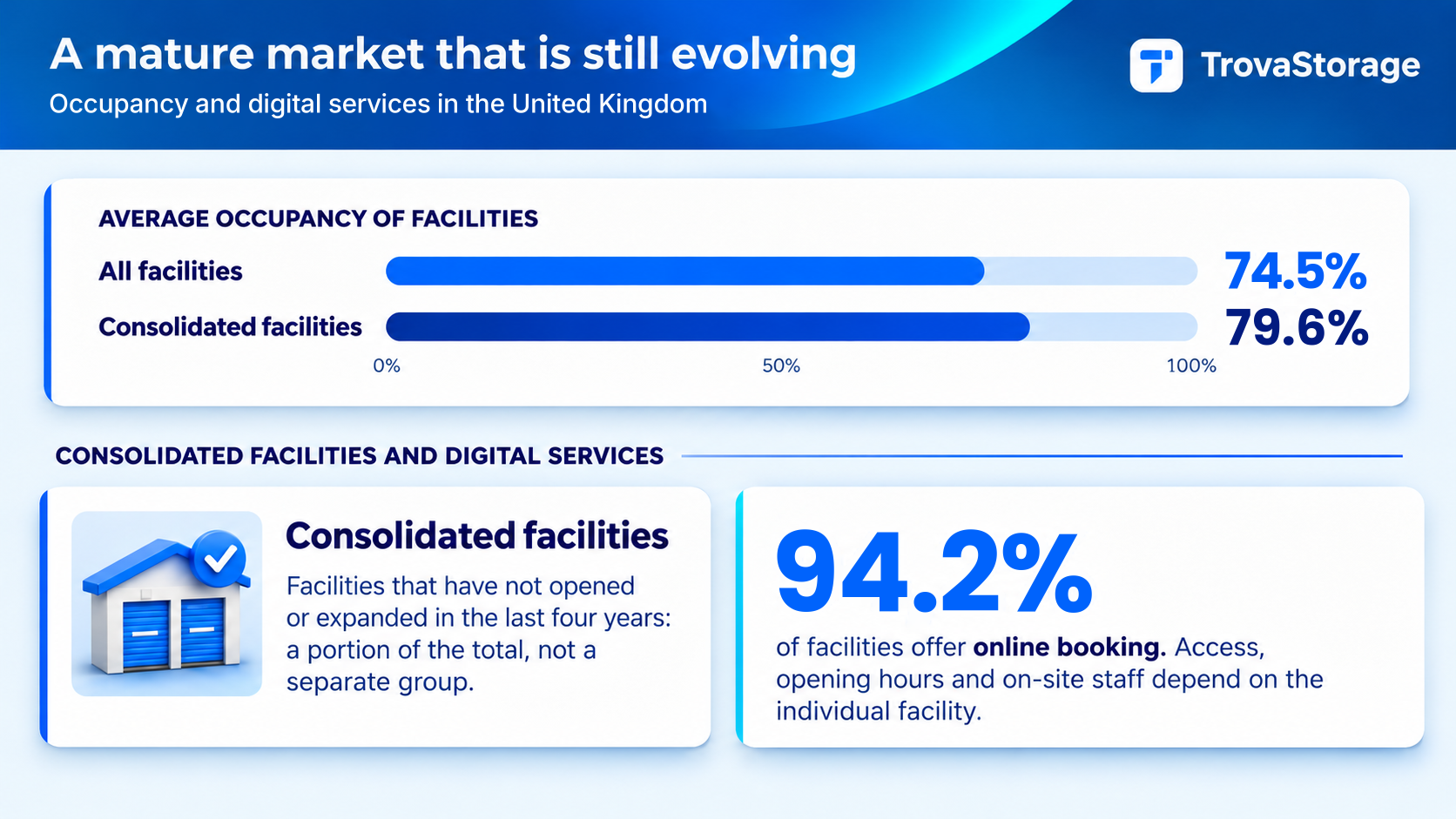
According to the SSA UK 2026 report [2], 94.2% of the facilities surveyed offer online booking, and this can make the first contact with the operator easier.
Digital booking, smartphone entry and remote management are, however, different features that depend on the individual facility. Some operators use electronic systems to control entry, others offer traditional access arrangements with staff on site at certain times.
Another interesting point concerns recently opened facilities. The report shows that, across all facilities, on average 74.5% of the space is occupied. If you look only at consolidated facilities, meaning those that have not opened or expanded in the last four years, the figure rises to 79.6%. They are not a separate group: they are a portion of the facilities already included in the total.
The difference, slight as it is, is easy to explain. A newly opened facility needs time to become known and fill its units, while one that has been running for years already has a stable customer base. That is why new openings pull the overall average down a little.
These percentages, however, do not tell you whether a unit is free in a given city. Availability varies from facility to facility, from area to area and also with the time of year. The only way to find out is to ask the facilities directly.
The British experience shows how self storage can become a familiar service, useful at very different moments in life. It also shows that, even with many facilities available, it always pays to compare them and choose the one that best suits your needs.
It is a useful point for Italy too, where self storage is still less widespread and many people only discover it when they face a move or a renovation.
Our European journey has only just begun. In the next instalment we will move to France, another large European market, to understand how facilities have developed there and how well the service is known among the population.
Sources
- Self Storage Association UK and Cushman & Wakefield, UK Self Storage Annual Report 2026.
- Self Storage Association UK and Cushman & Wakefield, UK Housing Squeeze Drives Continued Growth In Self Storage Sector, press release, 29 April 2026.